Put yourself in the customer's shoes. They've packed up their old phone, posted it, watched the tracking ping every status — out for delivery, delivered, signed for — and seen the email saying their device has been received and tested. Then nothing. A day. Two days. Five days. They're not waiting for a confirmation any more; they're waiting for money. And every silent day chips at their confidence that the money is actually coming.
The ripple effects are bigger than you think
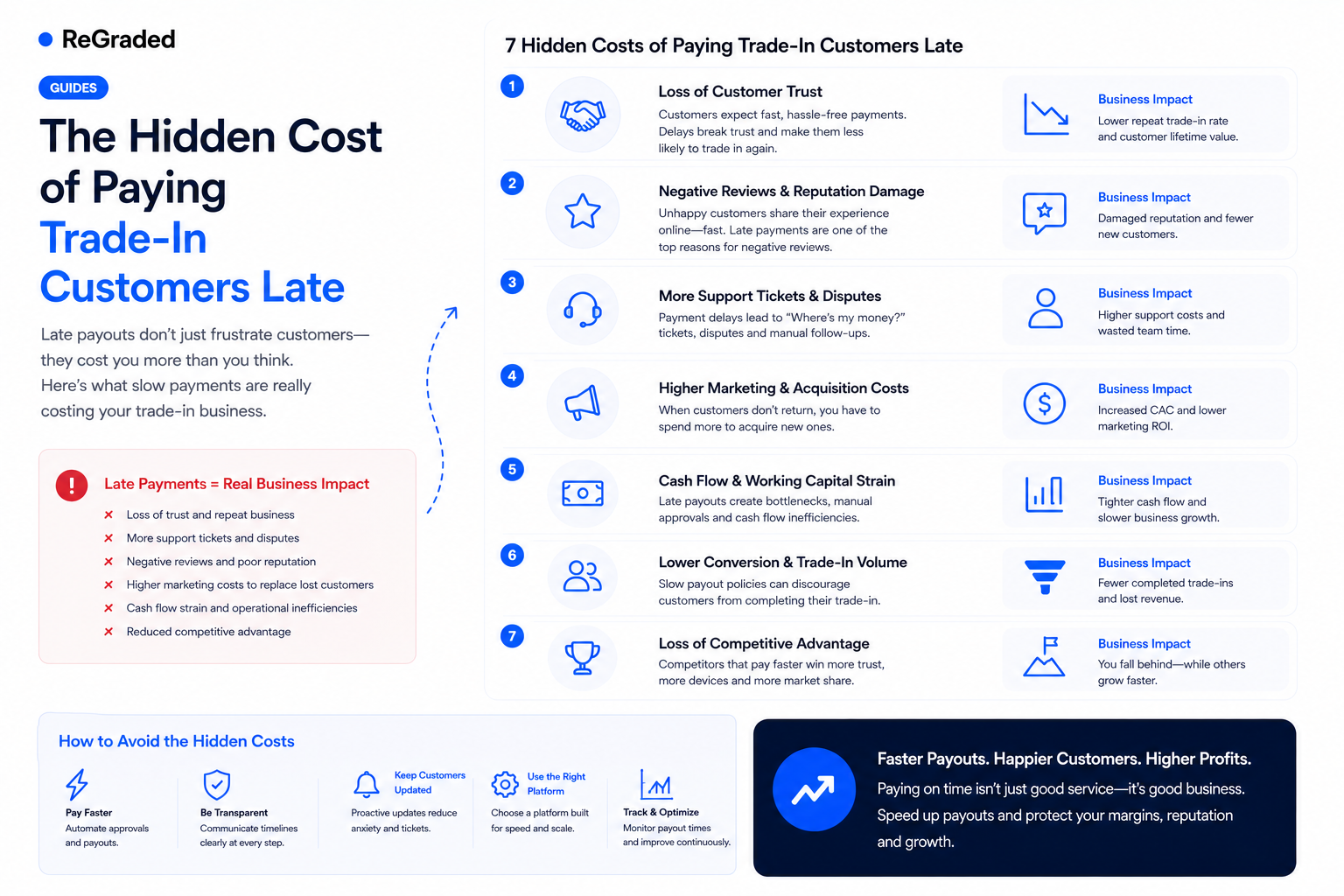
Late payments don't just upset the individual customer; they scale into structural problems. Trustpilot is brutal for buyback companies — search any of your competitors and you'll see the same pattern of one-star reviews mentioning "still waiting for payment" or "had to chase three times". Each one of those reviews is permanent, public, and disproportionate; it'll be read by hundreds of would-be customers who won't book because of it.
Beyond reviews, there's the inbound support burden. Every late payment is a customer service ticket, sometimes three or four if the customer chases. That's staff time you'd rather spend on revenue work. And every chased payment is a repeat-business customer you've lost — because nobody who waited a week for £80 sends you their next phone.
Why payments get late
The honest answer is that manual payment processing doesn't scale. The workflow most early operators use is roughly: at the end of the week, export a list, log into the bank, type each transfer one at a time. At twenty devices this is annoying but doable. At a hundred it's a four-hour job that's easy to skip "until tomorrow". At three hundred it's broken — payments slip into next week, errors creep in, some customers get paid twice and some not at all.
Worse, when a payment fails — wrong sort code, mistyped account number, closed account — there's no system to catch it. The money goes out, comes back days later, and nobody notices until the customer chases. Now the payment is two weeks late, the customer is furious, and you've still got to fix the underlying detail before you can re-send.
What batch payments fix
A proper trade-in platform processes payments in batches, not individually. You generate a batch of every device ready to pay, review the totals, and authorise the lot in a single action. Behind the scenes, the platform pushes the transfers, tracks each one's status, and surfaces any failures the moment they happen. What used to be a half-day job becomes a thirty-second one.
The economic effect is significant: with batch processing, paying customers becomes so trivial that operators move from weekly to daily payment runs without thinking about it. Customers go from "paid within 5 working days" to "paid same day as testing" — which is a category difference in customer experience, not an incremental one. Batch payment processing is where this transformation happens.
Failed payment recovery
Even with batch processing, payments fail — that's a fact of life. What separates a professional operation from an amateur one is what happens next. A proper platform should:
Detect failed payments automatically from bank or payment provider responses.
Flag the device back into a "payment failed" status that's visible on the dashboard.
Notify the customer immediately with a self-service link to update their bank details.
Retry the payment automatically once details are corrected, without staff intervention.
Without this loop, every failed payment is a manual investigation. With it, the customer fixes their own details and the system pays them — usually within hours of the original failure. That's the kind of operational discipline that turns SLA promises into reality.
Customer self-service makes the difference
The single highest-leverage feature for payment timeliness is giving customers a self-service account where they can view and update bank details. When details are wrong, the customer fixes them — without emailing you, without waiting for office hours, without a single staff hour involved. Customer accounts aren't a nice-to-have; they're the reason your payment SLA holds up under volume.
SLA tracking matters internally too
Even with great tools, you can't manage what you don't measure. The platform should track payment SLA — time from testing complete to payment sent — and surface any devices breaching it on the operator dashboard. Most operations don't have a payment problem because they're trying to be slow; they have one because nobody's watching the queue. Make breaches visible and they don't accumulate.
The promise to make
"Paid within 24 hours of testing" is one of the most powerful claims a trade-in business can make publicly. It's exactly what customers want, it directly addresses the trust gap that destroys reviews, and it differentiates you from competitors who measure payment in working days. But it's only credible if your platform can deliver it consistently — which means batch payments, automatic failure recovery, customer self-service, and visible SLA tracking, all running together.
If you'd like to see batch payments work live, we'll show you a real payment run from generation to confirmation. And pricing includes the full payment stack — batch processing, failed-payment recovery, customer accounts — at every tier, because none of it is optional if you want to keep your reviews intact.