If you've ever sketched out a trade-in business on the back of an envelope, the conversation usually goes one of two ways. Either you start hunting for an off-the-shelf platform, or you think: "I'll just build it myself — how hard can it be?" The second instinct is natural, especially if you have a developer friend, an agency relationship, or a CTO with time on their hands. It's also where most independent operators quietly lose six months and a five-figure sum before they ever buy their first device.
This is a deliberately honest comparison. Not "off-the-shelf good, custom bad" — there are legitimate reasons to build. But before you commit, it's worth knowing what you're actually committing to.
The real scope of a trade-in platform
Most people underestimate the surface area by an order of magnitude. A complete trade-in platform isn't one thing — it's about a dozen interlocking systems:
Customer-facing website with device search, condition selection, network handling, quote flow, and a checkout-style booking.
Admin dashboard covering every device in every status, with filtering, search, batch actions, and reporting.
Pricing engine that supports variants (model + storage + network), per-condition pricing, and comparison-site overrides.
Payment system with batch processing, multiple payout methods, failed-payment recovery, and full reconciliation.
Shipping integration with label generation, tracking sync, and SLA flags for unposted bookings.
Email system — twenty-plus transactional templates, branded for every operator, sent reliably at every status change.
Customer accounts with order history, bank detail updates, and return management.
Walk-in module for counter buying with instant payment and ID capture.
Bulk order processing for business and trader inbound.
Grading and testing with configurable checklists, photo capture, and pass/fail logic.
Audit trail — every action logged against the device, staff member, and timestamp.
Security, including encrypted bank details, role-based access, and tenant isolation if you ever want a second brand.
Every one of those bullets is a project in its own right. Skip any of them and you've shipped a website, not a platform.
The honest cost breakdown
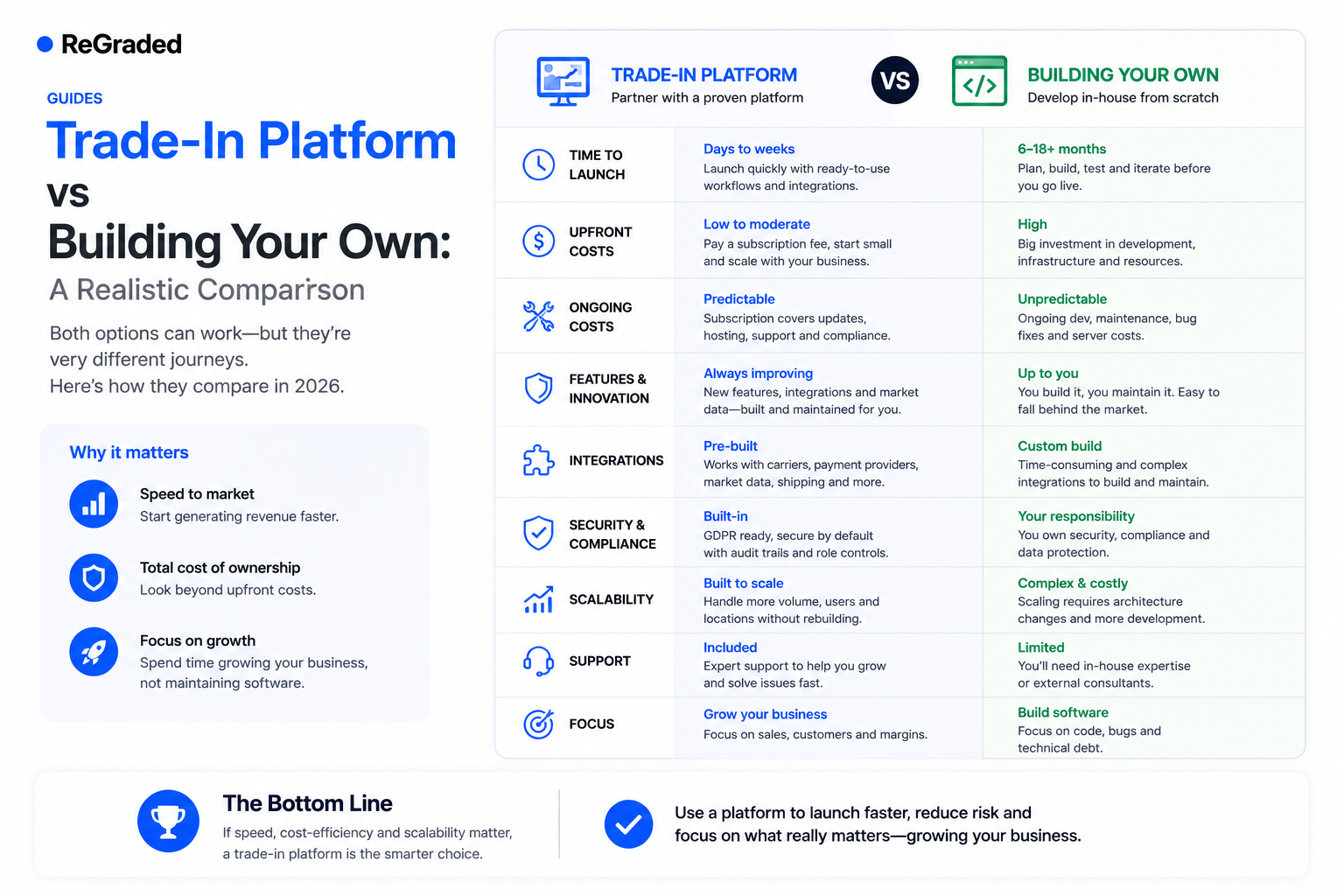
Pricing a custom build properly is brutal. Even with a competent agency or a contract team, a credible v1 lands somewhere between £15,000 and £50,000 upfront, plus £1,000–3,000/month in ongoing maintenance, plus six to twelve months of elapsed time before launch.
And that's the optimistic figure. It assumes nothing breaks, scope doesn't creep, and you don't discover halfway through that comparison site integration needs a different data model than you specced. Most builds run 30–50% over budget; we go into the true cost of building your own platform in more detail elsewhere.
Compare that to a purpose-built platform. ReGraded pricing starts at £99/month, with a one-time £399 setup fee. You have a preview site in 48 hours rather than waiting two quarters, and the entire feature set described above is included from day one. The headline saving is the five-figure upfront cost — the real saving is the year you didn't spend building before you started earning.
What people forget about ongoing costs
Even after launch, a custom build is a permanent liability. You'll need security patches every few months, dependency updates when frameworks deprecate, scaling work when traffic grows, and feature additions every time you spot something a competitor does. None of that is free. The £1,000–3,000/month maintenance figure assumes someone is actively keeping the platform alive — and that's before they build anything new.
On a SaaS platform, all of that is included. The platform gets better while you sleep, because every other operator on the platform is funding the same roadmap.
The opportunity cost most people miss
Here's the part that rarely shows up in a spreadsheet. Every hour your developer spends building the trade-in platform is an hour they're not spending on your actual business — your marketing, your pricing strategy, your retail operations, your relationships with refurbishers. The cost isn't just the invoice; it's the year of attention you put into infrastructure instead of into the business that infrastructure was supposed to enable.
Operators who use a platform from day one tend to get to market faster, learn faster, and reinvest the cash they didn't burn on development into stock and marketing — the two things that actually move trade-in volume. This is the same logic we cover when people ask about hiring a web designer: the trade-in business is a software product, and software products are very rarely worth rebuilding from scratch when a proven one exists.
When custom does make sense
There are legitimate reasons to build. If you have wildly non-standard pricing logic, a niche device category nobody else covers, or specific integrations into a proprietary backend, custom can be the right call. But the honest test is this: are you building because you have a unique requirement, or because you assume it'll be cheaper and faster than a platform? In the first case, build. In the second, the assumption is almost always wrong.
The right question to ask first
Before pricing a build, take the comparison the other way. Look at a platform that already has 150+ features, list the ten things you'd need that it doesn't do, and ask honestly whether those ten things justify a five-figure invoice and six months of waiting. For most operators, the answer is no — and the cash you'd have spent on development funds the first year of buying volume instead.
If you'd like to walk through the comparison live, we'll show you exactly which of your "must-haves" are already built. Or see the 48-hour onboarding process to understand how quickly you could be live.