Pricing is the single most important decision a trade-in operator makes, and the one most likely to be made on instinct. Pay too much and you erode the margin that keeps the lights on; pay too little and customers take their devices elsewhere. The operators who stay profitable treat pricing as a system to be managed, not a number to be guessed. Here's how to build one.
Start with the margin, not the price
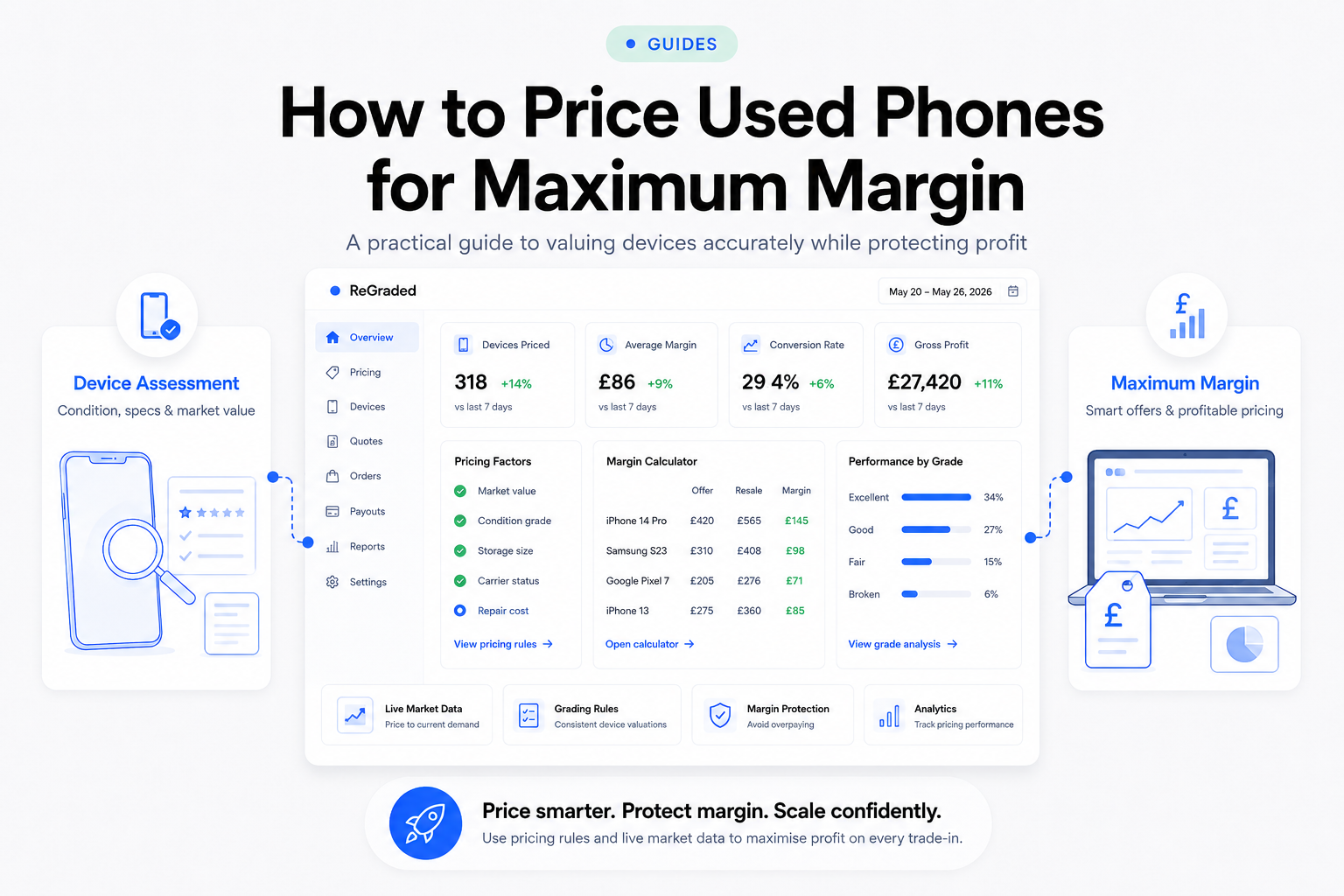
Every trade-in has two numbers: what you pay the customer (your buy price) and what you eventually sell the device for (your resale price). Your margin lives in the gap between them, and it has to cover more than profit — testing time, the occasional device that fails, payment fees, postage, and the small percentage of stock that never sells. A useful habit is to work backwards: start from a realistic resale figure, subtract the margin you need to run the business, and let that set your buy price. Pricing forward from "what feels fair" is how operators quietly lose money on every other deal.
Grade in tiers, and define them precisely
Condition-based pricing is the backbone of the whole model. Most operators use three tiers, and the money is in defining them tightly enough that two different staff members grade the same phone the same way. Write the definitions down — a vague grade is an argument waiting to happen, and arguments cost you either margin or a customer.
Excellent
No visible marks, full working order, everything as close to new as a used device gets. This is your top price, and it should be reserved for the devices that genuinely earn it.
Good
Light, honest wear — the odd faint scratch — but flawless function and a healthy battery. Most devices that arrive will land here, so this tier does the heavy lifting in your grid.
Fair
Visible scratches, scuffs, or a tired battery, while still fully functional. Priced conservatively, because these carry the widest range of actual condition and the most resale risk.
Don't price a model — price a variant
A single "iPhone 15" price will cost you money, because the device behind that name varies enormously. Storage matters: a 256GB phone is worth meaningfully more than the 128GB version, and pricing them the same means overpaying on one and losing the other. Colour can carry a small premium or penalty depending on demand. Treat each combination of model, storage, and finish as its own line with its own price. The detail is tedious to set up once and pays for itself on every transaction afterwards.
Account for network lock
Whether a phone is unlocked or tied to a carrier changes its resale value, sometimes sharply. An unlocked device sells to anyone; a locked one sells to a smaller pool, often at a discount, and may need unlocking before you can move it on. Build that difference into your grid rather than discovering it at resale. If you take locked devices at all, price them for the reality of what they cost you to sell.
Track the market — weekly, not yearly
Used phone prices drift constantly, and they fall fastest around new model launches. A grid you set in January and forget will be wrong by spring. Check what the established players and comparison sites are paying, watch for the step-downs that follow a new release, and adjust. You don't need to be the highest payer — you need to be close enough that price isn't the reason a customer walks, while protecting the margin that keeps you solvent.
The mistakes that quietly drain margin
Overpaying for Fair condition. Heavily worn devices carry the most resale risk; price them conservatively.
Ignoring testing failures. A percentage of devices won't pass. If your pricing assumes a 100% pass rate, your real margin is lower than you think.
Missing market drops. Prices that lag the market by a few weeks turn your best-selling models into your least profitable ones.
Pricing by memory. If the figure lives in someone's head, it isn't consistent, and it can't be improved.
Let the system hold the grid
All of this is manageable by hand for a handful of models. Past that, a configurable price grid that updates everywhere at once becomes the only way to stay consistent. ReGraded handles pricing as structured data — per model, per storage, per condition, per network — so a change you make is the price your customers see and your staff quote, with no copy-pasting between a spreadsheet and a counter. Every feature is included on every plan, from £99/month, so price management isn't something you bolt on later.
Pricing is a process
The operators with the healthiest margins aren't the ones with a secret number. They're the ones who treat pricing as an ongoing discipline — tiered, variant-level, network-aware, and reviewed often. Build the grid properly, keep it current, and let the platform enforce it consistently. Do that, and margin stops being something you hope for and becomes something you manage.