When a company replaces five hundred laptops, or a school swaps out two hundred tablets, those devices don't vanish — they need disposing of, securely and accountably. That's the world of IT asset disposition, and it represents one of the most lucrative, most predictable opportunities in the trade-in business. The catch is that you can't handle it the way you handle a single phone over the counter. Corporate volume needs corporate systems.
A market that refreshes on a clock
Organisations replace their devices on cycles — typically every three or four years — which makes the supply unusually predictable. Schools refresh tablet fleets over the summer; offices rotate laptops as leases end; hospitals and large enterprises retire hardware on rolling schedules. For a trade-in operator, that's a pipeline of high-volume, recurring work that doesn't depend on footfall or marketing spend. Win one corporate refresh contract and you've often won the next one too. Because these contracts recur on the client's own replacement cycle, the effort of winning one is repaid across years of predictable repeat work — the most valuable kind of customer a trade-in business can have.
What makes corporate different
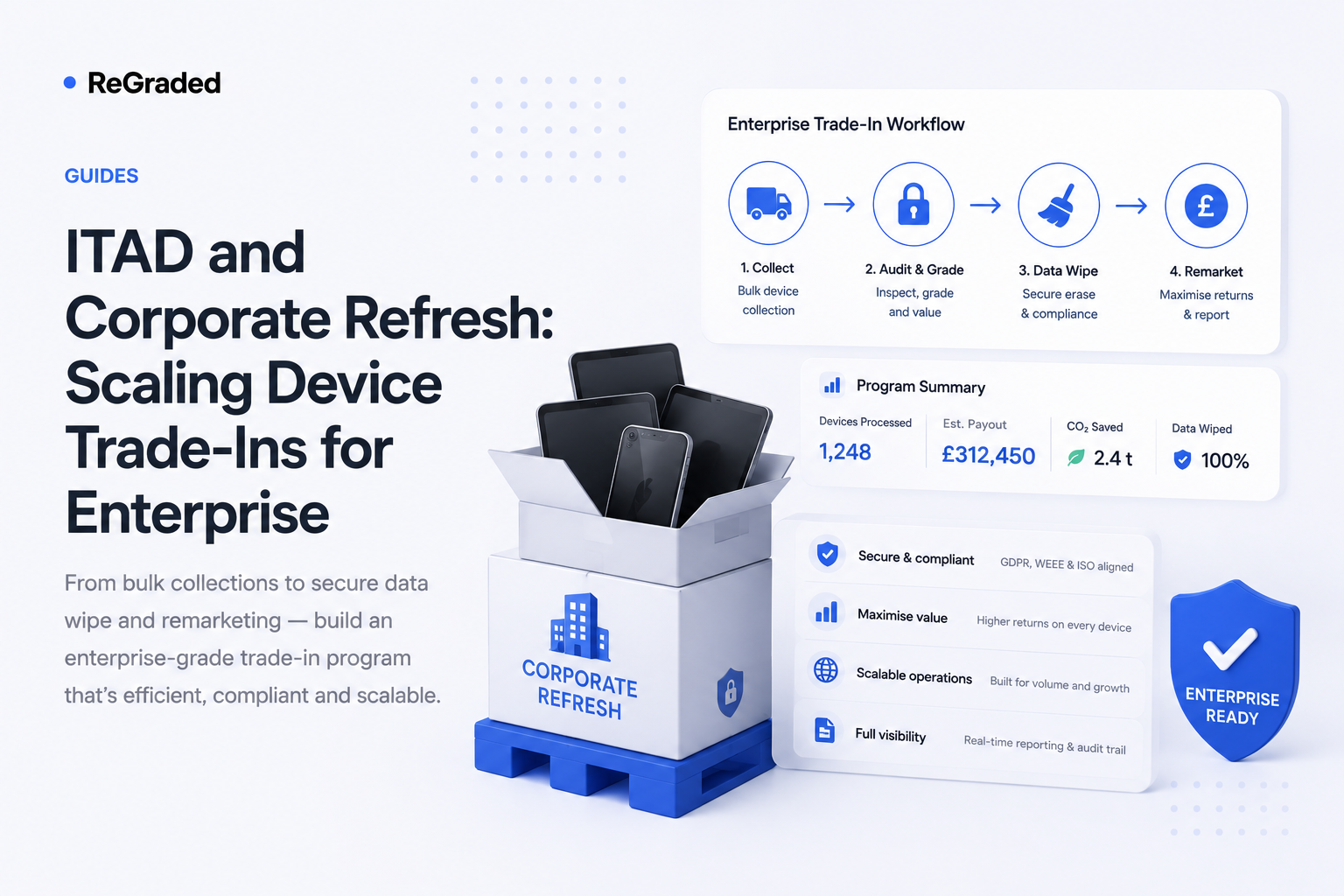
A consumer trade-in is one device and one customer. A corporate refresh is hundreds of devices, one contact, and a set of expectations a high-street process simply can't meet. The client needs bulk handling rather than one-at-a-time data entry, documentation they can show their own auditors, a complete record of every device's journey, and confidence that data has been dealt with properly. Meet those needs and you're not just buying phones — you're providing a service businesses will pay a premium for.
The bulk import workflow
The practical heart of an ITAD job is the spreadsheet. The client sends a list — five hundred devices with makes, models, and serial numbers — and the last thing you want is to key that in by hand. A proper bulk workflow lets you upload the file directly: the system validates it, flags anything that doesn't make sense, and creates a trade-in record for every line in one go. What would be a day of data entry becomes a single import.
Processing at volume
Once the devices arrive, the same principle applies to everything downstream. You grade in sessions rather than one device at a time, issue offers in bulk, and settle payments in a single batch rather than hundreds of individual transfers. The work scales with the contract instead of multiplying against it — which is the only way a five-hundred-device job is profitable rather than punishing.
Compliance is the product
For corporate clients, the documentation isn't paperwork — it's the reason they chose you. Every device needs to be tracked from receipt to resale, every action logged, and the whole lot exportable into a report the client can hand to their own finance or compliance team. The operators who win and keep ITAD contracts are the ones who make this effortless: clear records, secure data handling, and reporting that stands up to scrutiny. Get it right and compliance stops being overhead and becomes your competitive edge.
Data destruction is non-negotiable
For corporate clients, the single biggest anxiety isn't price — it's data. A retired work laptop or company phone can hold years of sensitive information, and the organisation disposing of it stays legally responsible for that data until it's verifiably gone. That makes secure data wiping, and a certificate proving it happened, a core part of the service rather than an optional extra. If you can demonstrate a clean chain of custody — received, wiped, resold, all logged — you remove the objection that ends most ITAD conversations before they begin.
How to win the contracts
Corporate buyers are choosing a partner, not a price. They want fast turnaround so a refresh isn't held up, clear documentation so their auditors are satisfied, and systems that demonstrably handle volume without dropping devices. Turning up with a professional platform and a clean process is often the entire pitch — it tells a procurement manager that you can be trusted with five hundred assets and the data on them.
Built to scale
This is exactly the kind of work ReGraded is built to support. The ITAD setup is designed around bulk volume — spreadsheet import, batch grading and payment, and a full audit trail on every device — while the same trade-in management pipeline that runs your consumer business handles the corporate side without a separate system. You scale into enterprise work without rebuilding how you operate.
The bottom line
ITAD and corporate refresh turn the trade-in model on its head: fewer customers, far more devices, and revenue you can forecast. The barrier was never demand — it was having the systems to process volume and prove compliance. With those in place, the company refreshing five hundred laptops next quarter isn't a logistical headache. It's the best contract you'll sign all year.