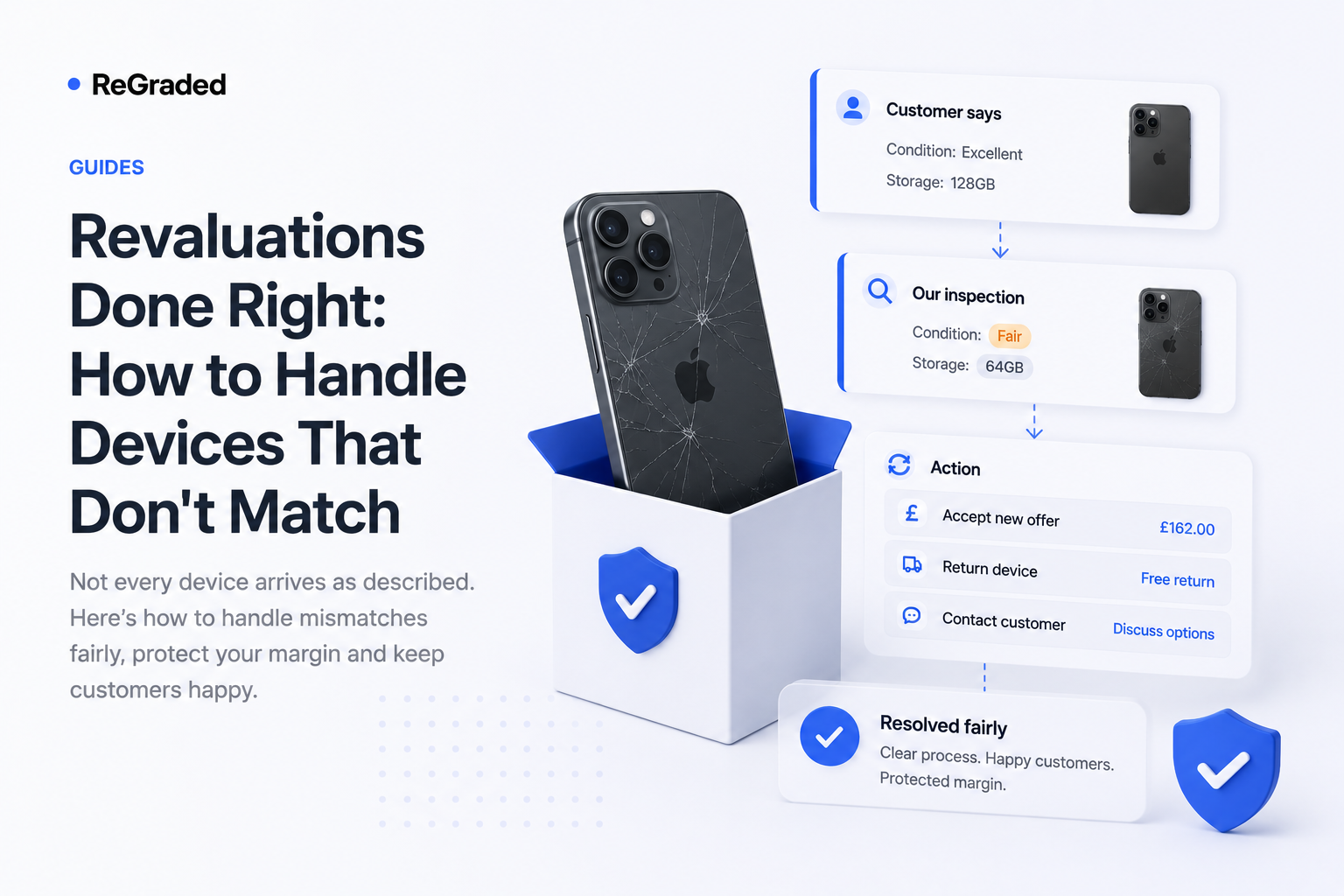
It's the most predictable problem in the trade-in business, and one of the trickiest to handle well. A customer books in a phone they've described as "Excellent". It arrives with a cracked back glass and a battery that's seen better days. The price you quoted no longer reflects what you've received — but how you handle the next five minutes determines whether you keep your margin, keep the customer, or lose both. This is the art of the revaluation, and it's worth getting right.
It's going to happen — a lot
Depending on your customer base, somewhere between a fifth and two-fifths of trade-ins need revaluing. Most of the time it isn't dishonesty; people are simply optimistic about their own devices and unsure how to grade a scratch. Whatever the cause, a meaningful slice of your incoming devices will be worth less than the original quote, so revaluation isn't an edge case to bolt on later. It's a core part of the workflow that deserves to be designed properly from the start.
The wrong way to do it
The damaging approach is blunt: an email that says, in effect, "your phone is worth less than we said — take it or leave it." It might be accurate, but it reads as a bait-and-switch, and customers respond accordingly — complaints, chargebacks, and the kind of public review that costs you ten future customers. A revaluation handled carelessly doesn't just lose one deal; it poisons the well.
The right way to do it
A good revaluation does the opposite. It explains, it evidences, and it offers a genuine choice. The customer should receive clear photos of the actual issues, a plain-language explanation of why the price has changed, the specific revised offer, and a real decision: accept the new amount, or decline and have the device returned. When someone can see the cracked glass for themselves and understands the reasoning, most accept — and even those who don't tend to leave feeling fairly treated rather than ambushed.
Always offer the way back
The return option is what keeps a revaluation honest. If a customer doesn't like the revised offer, they should be able to get their device back rather than feeling trapped into accepting. How you handle the cost is a business decision: some operators return devices free as a goodwill gesture, others apply a modest return fee to cover postage and discourage chancers. Both are defensible — what matters is that the option exists and is stated up front, so "no" is always available.
One issue often hides another
Revaluations aren't always a single round. You flag the cracked back, the customer accepts, and then testing reveals the battery is below threshold too. A workable process has to handle multiple rounds without losing the thread — each revised offer recorded, each response captured, the full history visible on the device. If your system can only cope with one adjustment, the second one throws everyone back into manual email and memory.
Don't let them go cold
Nothing frustrates a customer like a revaluation that sits in limbo. They've been told their device is worth less and then heard nothing for four days — that silence is where complaints breed. Revaluations need a clock on them: clear timelines, automatic follow-ups, and visibility of anything that's been sitting unanswered. Speed and communication turn a negative moment into a professional one.
How a proper workflow handles it
This is precisely the kind of process that benefits from being built into the platform rather than improvised. ReGraded's trade-in management treats revaluation as a first-class flow: you attach photos and a reason, send a revised offer to a secure customer link, and the customer accepts or declines from there. Every cycle writes its own record, so the history is complete however many rounds it takes; declined offers move cleanly into a return process; and SLA timers flag anything ageing before it becomes a complaint.
Tone does as much work as price
Two operators can send the identical revised figure and get opposite reactions, purely on framing. "Unfortunately your device is worth less than quoted" invites an argument; "here's what we found, here are the photos, and here's your revised offer — the choice is entirely yours" invites a decision. Lead with the evidence, keep the language plain and matter-of-fact without being cold, and always make the options explicit. People rarely object to a fair process, even when the number moves against them — what they object to is feeling cornered.
The bottom line
Revaluations are inevitable, but unhappy customers aren't. The operators who handle mismatched devices well don't do it with a sharper email — they do it with transparency, evidence, a fair choice, and a fast, documented process. Handle the awkward moment professionally and you protect your margin without sacrificing the reputation that brings the next customer through the door.