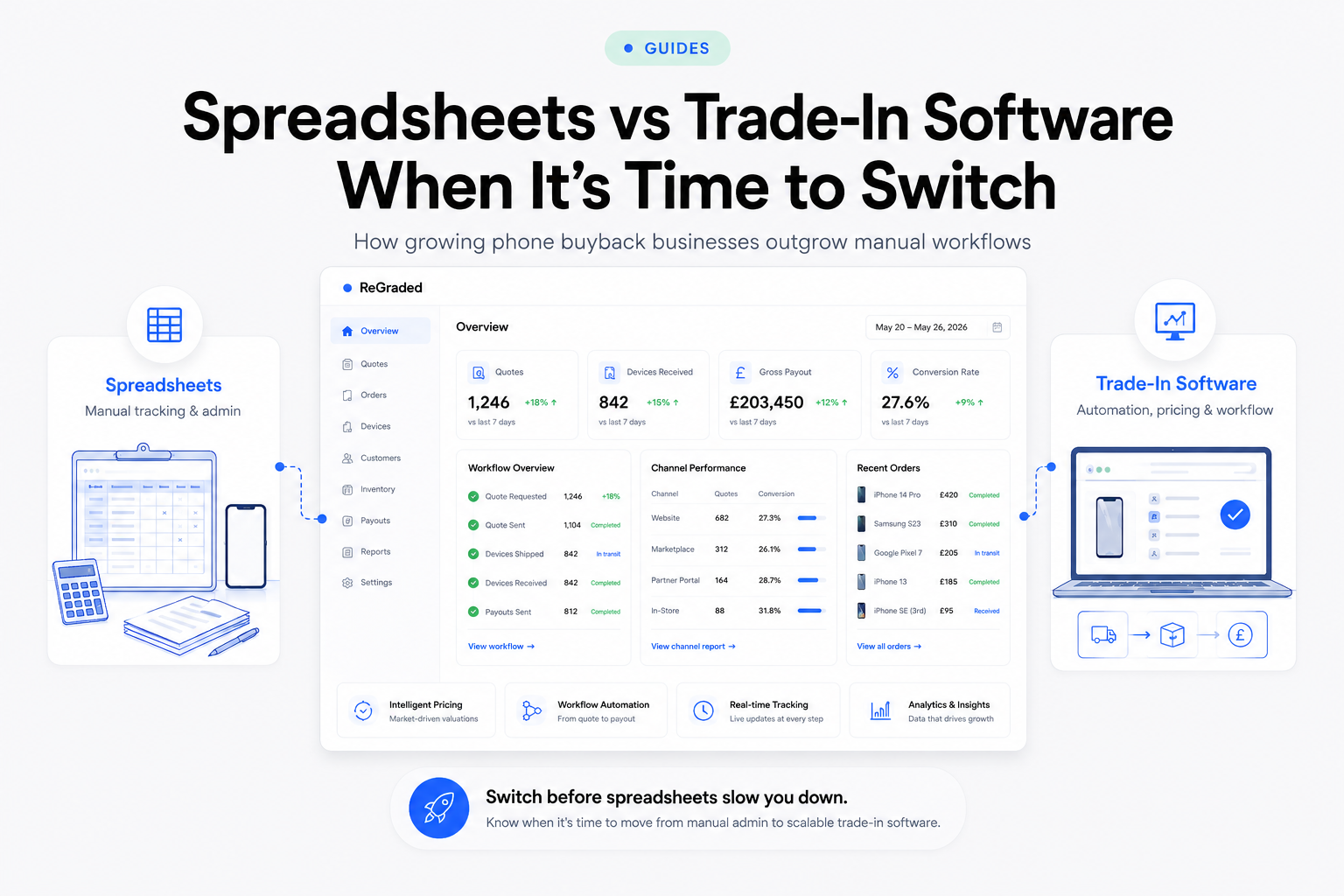
Almost every trade-in business starts in a spreadsheet, and there's no shame in that. A spreadsheet is free, instantly understood, and perfectly adequate when you're processing a handful of devices a week. The problem is that it never tells you when you've outgrown it — it just quietly starts costing you money. Here's how to recognise the moment to move on.
The warning signs
You've probably outgrown the spreadsheet when you start seeing:
Follow-ups slipping — customers chasing you for updates because nothing reminds you to chase them.
Payment mistakes — paying the wrong amount, or paying twice, because the numbers live in three places.
No reliable status — "where is this device?" takes a conversation instead of a glance.
Copy-paste between sheets — the surest sign your process has outgrown its tool.
The risks hiding underneath
The inconvenience is the visible part. The real exposure is underneath. Data-entry errors on payments go straight to your bottom line — one fat-fingered figure and you've overpaid. No status tracking means devices genuinely get lost in the process, and a lost device is pure loss. GDPR liability is the quiet one: customer names, addresses, and contact details sitting in a shared Google Sheet is a data-protection incident waiting to happen. And with no communication trail, a single disputed offer becomes your word against theirs.
The tipping point
In practice, two thresholds tend to force the decision. The first is volume — somewhere around 50 devices a month, the manual admin stops being a minor chore and becomes a part-time job. The second is people: the moment you hire your first member of staff, an undocumented spreadsheet process becomes almost impossible to hand over cleanly. If either of those is on your horizon, you're already at the tipping point.
What trade-in software actually gives you
Moving to a dedicated system isn't about a prettier sheet — it's about the work that disappears entirely. A single pipeline holds every channel. Status-change emails send themselves. SLA timers flag anything ageing before a customer complains. Payments batch and reconcile instead of being typed out one by one. Customers update their own details through a self-service portal rather than emailing them to you. ReGraded's operations dashboard is built around exactly this — grouped queues, countdown timers, and a clear audit trail on every device.
Do the maths on your time
Here's the comparison that actually matters. Your time has a value. If you're spending two hours a day on admin that software would handle automatically, that's roughly forty hours a month — a full working week — lost to data entry. Measured against a platform that starts at £99/month, the spreadsheet stops looking free very quickly. It was only ever free in cash; it was always expensive in hours and in risk.
The bottom line
The spreadsheet isn't the villain — it got you here, and that's exactly what it's good for. But the tool that launches a business is rarely the tool that grows it. When the warning signs appear, treat them as a milestone, not a fire drill: it means the business is working, and it's ready for a system built to run it.