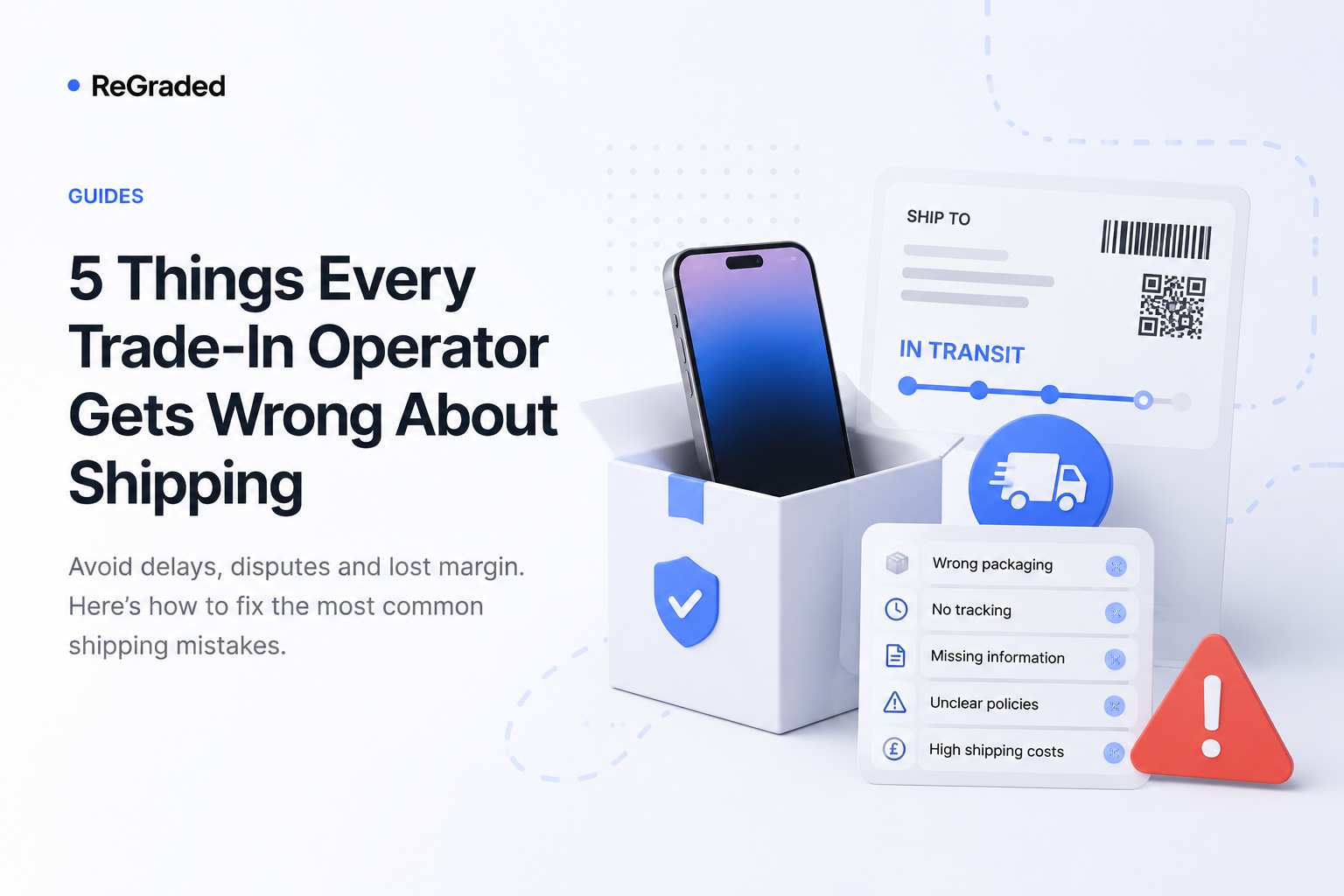
Shipping looks like the simplest part of a trade-in business. Customer posts a phone, you receive it — how hard can it be? Hard enough that logistics is where a surprising number of operators lose time, money, and customers. Devices go missing, support inboxes fill with "where's my parcel?", and someone spends their morning copying addresses into a postage tool one at a time. Here are the five mistakes that cause most of it, and how to avoid them.
1. Making the customer pay for postage
It feels reasonable — they're getting paid for the device, surely they can cover a stamp? In practice, asking customers to pay for postage is one of the fastest ways to kill your conversion rate. The moment someone has to find a box, weigh a parcel, and pay at the counter, a good portion of them simply don't bother. Free, pre-paid postage is no longer a perk; it's the baseline customers expect, and the cost is trivial next to a lost trade-in. Treat free postage as a customer-acquisition cost rather than an expense — it's one of the cheapest conversions you'll ever buy.
2. Generating labels by hand
One device a day, and pasting an address into Royal Mail's Click & Drop is fine. Ten devices a day, and it's a part-time job nobody wants. Manual label creation doesn't scale — it's slow, it's error-prone, and a single mistyped postcode turns into a misrouted parcel and a support ticket. The work grows in lockstep with your success, which is exactly the wrong way round.
3. Treating tracking as an afterthought
"Where is my device?" and "have you received it yet?" are, between them, the most common questions any trade-in business fields. Every one of them is a customer who's anxious and a member of staff who has to stop and check. When tracking is synced automatically and the customer can see the status themselves, that entire category of support load simply disappears. Tracking isn't a nice-to-have — it's the thing that stops your inbox becoming a parcel-finding service. It also quietly lifts your ratings: customers who can see exactly where their device is don't feel the anxiety that drives so many negative reviews.
4. No grip on the packs in flight
At any given moment you have devices that have been quoted but not posted, packs dispatched but not arrived, and parcels that are overdue and need chasing. Operators who don't track this lose devices in the gaps — a customer who never posted, a parcel that stalled, a booking that quietly went cold. You need to know, at a glance, what's outstanding and what's overdue, so you can follow up before a device becomes a write-off.
5. Forgetting the return journey
Not every trade-in ends in a payment. Sometimes a customer declines a revised offer and wants their device back. If you haven't designed that return flow, it becomes a scramble every time — a manual label, an awkward email, and a customer wondering whether they'll ever see their phone again. A proper process handles returns as a first-class outcome, with its own label and its own tracking, whether you absorb the cost or apply a return fee.
The compounding effect
None of these mistakes is fatal on its own. The danger is that they compound. A customer who paid for postage is already mildly irritated; when their parcel then can't be tracked, the irritation hardens into a support ticket; when the device sits unlogged for two days because nobody is watching the inbound packs, the ticket becomes a complaint; and when they decline a revised offer only to find there's no clean way to get their phone back, the complaint becomes a public review that costs you future customers. Each weak link makes the next one worse, which is why patching a single mistake rarely fixes the experience — you have to address the whole chain.
Automate the whole chain, not just the easy bit
The thread running through all five mistakes is the same: shipping treated as a series of manual tasks instead of an automated flow. Fix it end to end and the difference is dramatic. ReGraded's Royal Mail Click & Drop integration generates pre-paid labels automatically, syncs tracking so customers can follow their own parcels, surfaces which packs are outstanding or overdue, and produces return labels when an offer is declined — all from the same pipeline that runs the rest of the trade-in. It connects through Click & Drop and requires a Royal Mail Online Business Account (OBA) — free to set up with Royal Mail.
The bottom line
Logistics is rarely the part of a trade-in business anyone is excited about, which is precisely why it's so often neglected. But shipping is the part the customer experiences most directly — it's the waiting, the wondering, and the parcel on the doorstep. Get it smooth, free, and visible, and you remove most of the friction between a quote and a happy, paid customer. Get it wrong, and no amount of good pricing will save the experience.