Most trade-in businesses start with a single channel. A high-street phone shop buys devices over the counter; an online seller takes postal trade-ins through a website. Both models work. The operators who pull ahead, though, are usually the ones who run both at once — capturing local footfall and national reach without doubling their admin in the process. The trick isn't working harder across two systems. It's running both channels through one.
What walk-in buying does well
Buying face to face has real advantages. You inspect the device in front of the customer, so grading disputes essentially disappear — what you see is what you pay for. There's no shipping to arrange, no waiting for a parcel, and no risk of a phone going missing in transit. You can pay on the spot, which customers love, and the personal interaction builds the kind of trust that turns a one-off seller into a repeat one.
The limits are equally clear. Walk-in trade is capped by your location and your opening hours. You can only buy from people willing to travel to you, during the times your door is open. And if your process lives in a notebook or a spreadsheet behind the counter, every device still has to be logged, tested, priced, and paid for by hand.
What online trade-ins do well
Postal trade-ins flip the equation. Your shop is open every hour of every day, and your catchment is the whole country rather than a few surrounding postcodes. Volume scales without more counter staff, because customers do the booking themselves. For most operators, online is where genuine growth comes from.
The trade-offs are logistical. You don't touch the device until it arrives, so accurate condition grading on receipt matters enormously. You have to manage postage, tracking, and the occasional dispute when a phone turns up in worse shape than described. And payments happen after inspection, which means a clear, fast payout process is essential to keep customers happy.
Why you'll probably want both
Once you see the strengths side by side, the logic of running both channels is hard to ignore. Walk-in captures the local customer who wants cash today and the reassurance of a real shop. Online captures everyone else — the person three counties away who found you through a comparison site at eleven at night. Together they smooth out the quiet periods and let one business serve two quite different kinds of seller.
The hidden cost of two separate systems
Here's where most operators come unstuck. They bolt an online trade-in tool onto a shop that already has its own counter process, and end up running two systems that don't talk to each other. Prices drift apart between the website and the till. A device bought online is tracked in one place; a device bought in person is tracked in another. Reporting means stitching two exports together in a spreadsheet. The admin doesn't just add up — it multiplies.
The cost isn't only time. Two sources of truth means two places for errors to hide: a price updated online but not at the counter, a payment marked done in one system and still outstanding in the other. Every seam between systems is somewhere money can leak.
One pipeline for every channel
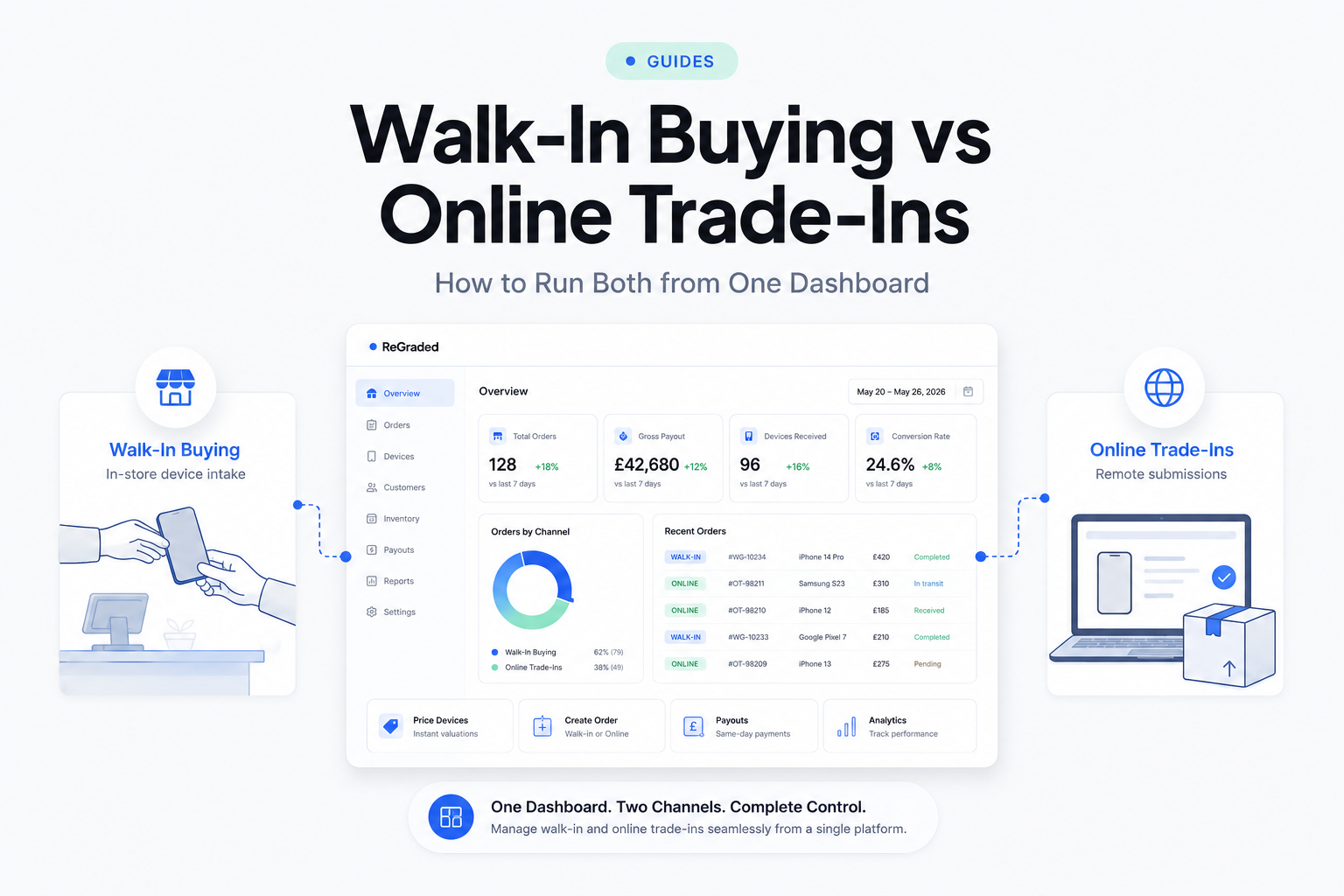
The fix is to treat the channel as a detail, not a separate business. A walk-in purchase and an online booking are the same thing — a device coming in to be tested, graded, and paid for — so they belong in the same pipeline, priced from the same grid and graded against the same checklist.
That's exactly how ReGraded's trade-in management is built. A walk-in creates a trade-in on the spot, valued from the same pricing as your website. An online customer books from your branded site, and that booking lands in the identical queue. From that point on there's no distinction: the same grading criteria, the same payment methods, the same status tracking, and the same audit trail on every device, however it arrived.
What it looks like day to day
In practice, your team opens one dashboard. The operations view shows everything live — counter purchases logged this morning alongside parcels arriving from last week — grouped by what needs doing next rather than by where it came from. Testing is one queue. Payments batch together regardless of channel. When you want to know how the business is doing, you look in one place and the numbers are already whole.
Consistency is the real prize
The deeper benefit of one system is consistency. When walk-in and online share a price grid, a customer can't get one quote on your website and a different one at your counter — a discrepancy that quietly erodes trust the moment someone spots it. When they share a grading checklist, a phone is judged the same way whether it's handed over in person or posted through the door. And when they share a single audit trail, every device carries one continuous history regardless of how it arrived. That consistency is invisible when it works and corrosive when it doesn't — and it's almost impossible to maintain across two disconnected tools.
The bottom line
Walk-in versus online was never really the question. Each serves a customer the other can't reach, and the strongest operators run both. What actually matters is whether your systems force you to run them as two businesses or let you run them as one. Get that right and adding a second channel costs you almost no extra admin — it just adds devices, and devices are the point.