Imagine the call. A customer insists they sent you an iPhone 15 Pro. Your records — such as they are — say you received an iPhone 14. They're adamant, you're adamant, and there's nothing between you but two conflicting memories. Without an audit trail, you can't prove your version, so you either eat the cost or lose the customer, and possibly earn a one-star review on the way out. This scenario plays out in every trade-in business eventually. An audit trail is how you make sure it ends in your favour.
Disputes are not the exception
It's tempting to treat disputes as rare events, but at any real volume they're routine. Customers genuinely misjudge their device's condition. Parcels get confused. Payments are questioned. The specifics vary, but the pattern is constant: someone claims something happened differently from how your system recorded it. The question is never whether these situations arise — it's whether you can answer them with evidence or only with assertion.
The scenarios you'll actually face
A customer says they sent Device A; the device you received is clearly Device B.
A customer claims a payment never arrived, when your records show it was sent and settled.
A customer disputes a revised offer, insisting the device was in better condition than your grading found.
A staff member processes something incorrectly, and you need to see who did what, and when.
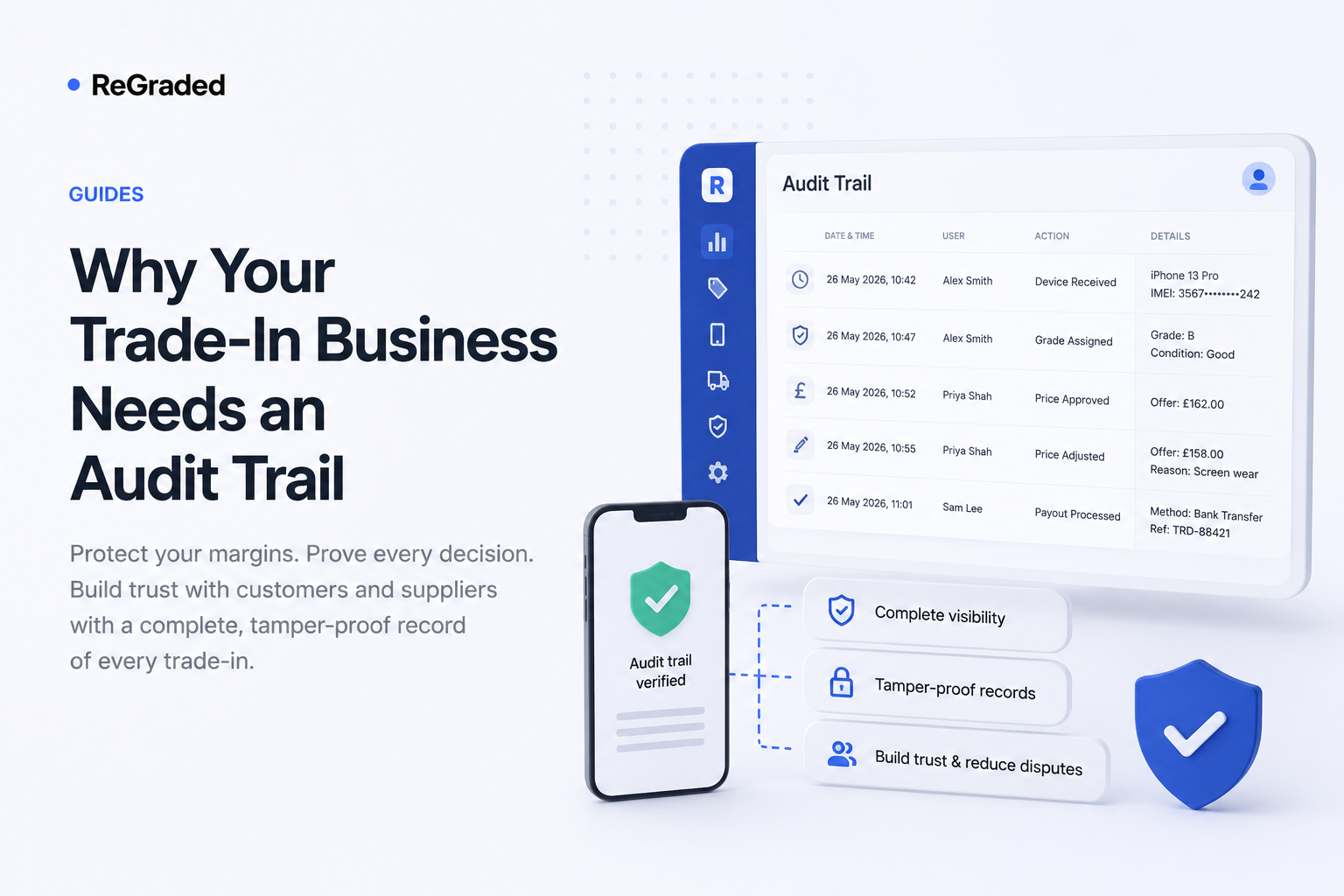
In each case, the difference between a quick resolution and a costly write-off is whether you have a timestamped, tamper-resistant record of what happened.
What a proper audit trail records
A real audit trail is more than an order history. Every status change is logged with a timestamp and the user who made it. Every customer email is recorded, so you can show exactly what was communicated and when. Every offer — original and revised — is documented. Photos taken during testing or revaluation are attached to the device they belong to, so a condition dispute is settled by looking, not arguing. The result is a single, chronological story of each trade-in that nobody can quietly rewrite.
The value beyond disputes
Winning arguments is the obvious benefit, but it isn't the only one. A complete record makes tax and financial reporting straightforward, because every transaction is captured rather than reconstructed. It exposes bottlenecks — if devices consistently stall at one stage, the timeline shows you where. And it creates genuine staff accountability: when every action carries a name and a time, standards look after themselves, and training a new starter becomes a matter of pointing at the record rather than explaining the folklore.
The GDPR dimension
There's a compliance angle that's easy to overlook. A trade-in business handles exactly the data regulators care about most — names, addresses, contact details, and the bank or PayPal information needed to pay people. Under UK data protection rules, you're expected to handle that responsibly and, if asked, to demonstrate that you did. An audit trail, combined with proper handling of sensitive fields, is a large part of how you show you're processing customer data accountably rather than leaving it scattered across inboxes and spreadsheets.
Keep the conversation with the device
There's a quieter benefit, too. When your team discusses a tricky trade-in — a borderline grade, an awkward customer, a payment to double-check — that conversation usually happens in a messaging app or across a counter, and then it's gone. Threaded internal notes attached to the trade-in itself keep that context where it belongs. The next person to pick up the device sees the whole history, not just the current status, and nothing depends on whoever happened to be on shift that day.
Built in, not bolted on
The important thing about an audit trail is that it has to be automatic. A log you have to remember to update is a log that's wrong by lunchtime. ReGraded writes an event for every meaningful change as it happens — the trade-in management pipeline records each transition, email, and offer without anyone having to think about it, and the platform's security model encrypts sensitive details and guards records once they're paid. The trail builds itself as you work.
When the bank gets involved
Chargebacks deserve a special mention, because they're where an audit trail earns its keep most directly. If a customer disputes a payment through their bank, you'll be asked to evidence the transaction — what was agreed, what was sent, and when. A business that can produce a timestamped record of the offer, the acceptance, and the payment usually prevails; one relying on "we definitely paid them" usually doesn't. The trail turns a he-said-she-said into a documented case the bank can actually rule on.
The bottom line
An audit trail is one of those things that costs nothing when everything goes right and saves you enormously the moment it doesn't. Disputes, chargebacks, compliance requests, and staff questions all resolve faster — and more often in your favour — when you can show exactly what happened. In a business built on trust and small margins, that evidence isn't bureaucracy. It's protection.