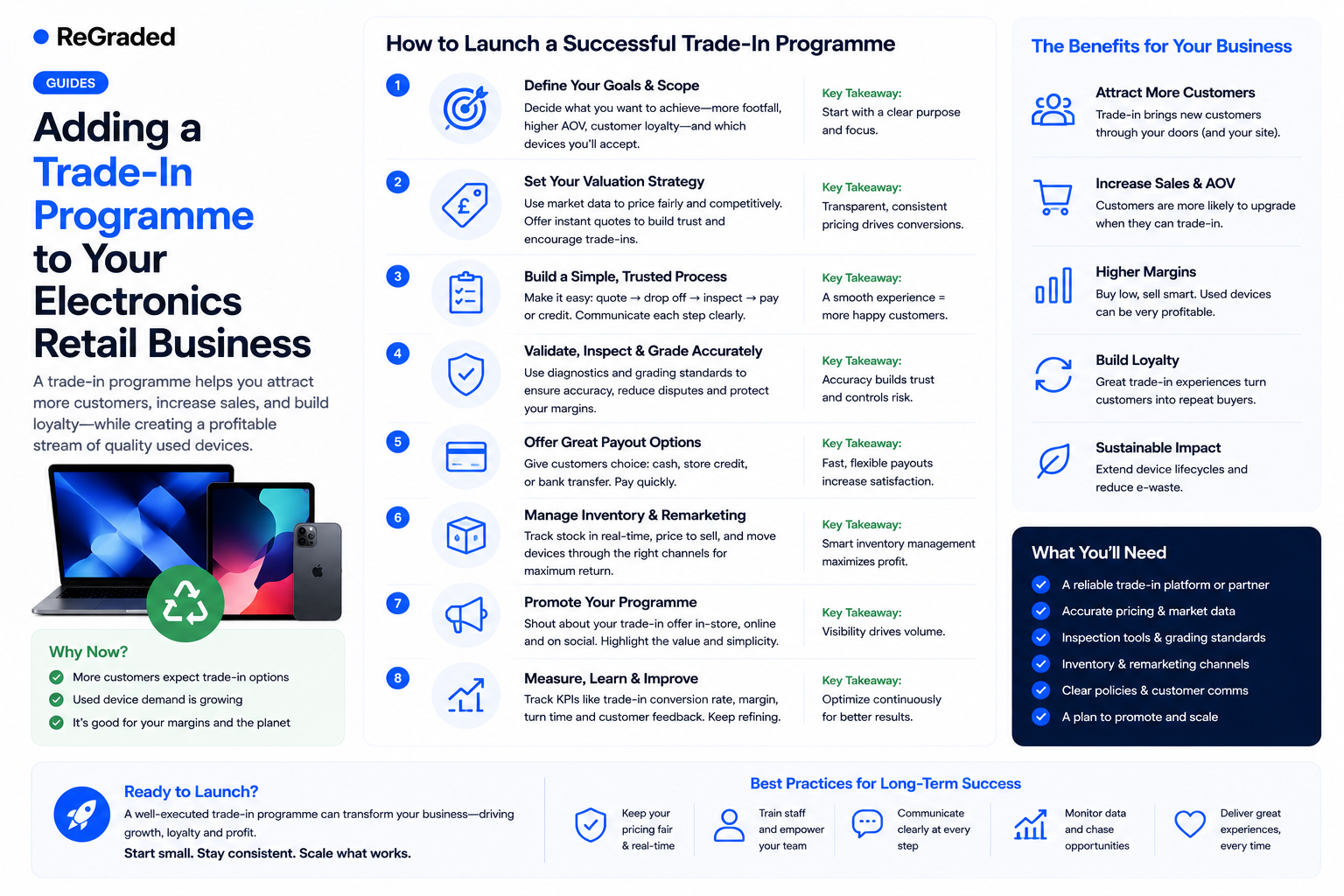
I started buying and selling used phones in 2015, inside Wireless Parts Ltd, a mobile phone parts business. Wireless Parts funded the build-out and our first stock, and that operation became WeBuyTek, a UK phone trade-in business I ran until 2024. At its busiest, WeBuyTek handled more than 1,000 phones a month with a team of six or more.
This is the guide I'd give anyone asking me how to start a phone buyback business in the UK today. It covers choosing your model, where your phones come from, the checks you make before you pay, testing and grading, pricing, how the money flows, posting phones, where to sell your stock, finding customers, the legal basics, the tools you need and a realistic first 90 days. Where I mention law or tax, I link to the official source. Treat that part as guidance, not legal advice.
If you only take one thing from it, take this: customer service and reviews matter as much as paying the highest price. I'll come back to why at the end.
What a phone buyback business actually is
A phone buyback business buys used phones from the public, and sometimes from businesses, checks and grades them, and sells them on for more than it paid. Your margin is the gap between the two prices, minus everything that happens in between: postage, testing, replacement parts, marketplace fees, returns and the time your money spends tied up in stock.
That last cost is the one people underestimate. You pay the customer once the phone has been checked, but you only get your money back when the phone sells. Almost everything in this guide is about making the gap wider and the wait shorter.
Is phone flipping profitable?
It can be. It was a business for us for nine years. But I'm not going to give you a margin figure, because there isn't an honest one. The same phone can make money for one operator and lose money for another, and the difference is almost always in how well they buy, test and sell.
Profit leaks away in predictable places: paying too much for a phone, grading it higher than it deserves, buying phones that need parts you didn't budget for, letting stock sit, and losing sales to fraud or returns. It comes from the opposite: quoting accurately, buying direct from the people who used the phone, grading the same way every time and selling through channels where you keep more of the price. I'll go through each of those below, and there's a fuller answer in is phone buyback profitable?
Step 1: Choose your model: online, walk-in or both
There are two ways to buy from the public, and many businesses end up doing both.
Online, by post. A customer gets a quote on your website (or through a comparison site), books the phone in, posts it to you, and you pay once you've checked it. You can buy from anywhere in the UK, and you can grow without opening more shops. The catch is that you don't see the phone until it arrives, so the customer's description and your grading decide whether the price holds. You need clear condition definitions, free and tracked postage, and a fair way of handling a phone that isn't what was described.
Walk-in, at a counter. You inspect the phone in front of the customer and pay on the spot. There's no postage, no waiting and far fewer disputes, because you both see the same phone. But you're limited to the people who walk past, and you need the checks and records described below done at the counter, every time, under the pressure of a customer waiting.
Both. If you already have a shop, adding online buying lets you reach customers beyond your town. If you start online, a counter can come later. What matters is that both channels price and grade the same way, so a phone is worth the same whichever door it comes through.
My advice is to start with one channel and get it working properly before you add the other.
Step 2: Sourcing: where your phones come from
We didn't start with trade-in. In the early days we bought phones on eBay and from private sellers, and we tried buying stock from suppliers. We moved to trade-in, buying direct from the public, quite quickly, and the reason was quality.
Wholesale stock was poor. Quality control was weak, phones arrived with hidden faults, and the condition often didn't match the grade we'd paid for. When you buy a box of phones graded by someone else, you inherit their grading and their problems, and you find out after you've paid. When you buy one phone at a time from the person who owned it, you check it yourself before any money moves, and you know its history: one owner, one set of answers.
We also hit the scams anyone in this trade will meet sooner or later:
- Blacklisted phones: phones reported lost or stolen, or blocked by a network, which you can't sell on honestly.
- Suppliers who took payment and never sent the stock.
- Counterfeit phones: phones made to look like a model they aren't.
Every one of those is cheaper to avoid than to recover from. Check before you pay, be wary of any supplier you haven't dealt with before, and don't let a good price talk you out of your checks. If you do buy wholesale stock later on, the same rules apply to every phone in the box.
Step 3: Check every phone before you pay
This is the step that protects your money and keeps you on the right side of the law. Do it the same way every time.
Stolen, lost and blocked phones
Find the phone's IMEI (dial *#06#, or look in the phone's settings) and check it against a blacklist database before you pay. Keep the result with your record of the purchase. Make sure the IMEI on screen matches the one on the SIM tray or in the settings: changing or interfering with a phone's IMEI is a criminal offence under the Mobile Telephones (Re-programming) Act 2002, so a phone whose identity doesn't add up is one to walk away from. There's more on this in IMEI checks for buyback businesses.
Activation Lock and Google lock
An iPhone with Activation Lock still on is tied to its previous owner's Apple Account, and Apple's own guidance is that removing it needs that owner's Apple Account details or passcode. Android phones have the same kind of protection through the Google Account: Google's help page warns that if the account details can't be given during setup after a factory reset, the phone can't be used at all.
We didn't buy locked phones. When one arrived still locked, we returned it to the customer. Ask the seller to sign out and remove the lock before they post the phone or hand it over, and make it clear in your terms that a locked phone comes back to them.
Record who you bought from
Keep the seller's name and address, the date, what you paid and how, and the phone's IMEI and description. It's the record you'll need if a phone turns out to be stolen, if the police or trading standards ask, and for your accounts. More on this in buying second-hand phones legally in the UK.
Step 4: Testing and grading
At WeBuyTek we tested every phone with our own internal checks plus Blackbelt360 diagnostics. A diagnostic tool runs the functional tests the same way every time, which is what you want: the same phone should get the same result whichever member of staff tests it, on a quiet Tuesday or a busy Friday.
Write your grades down. Each grade needs a definition anyone on your team can apply: what marks are allowed on the screen and the body, what battery health is acceptable, what has to work. If two people would grade the same phone differently, your definitions aren't finished. Consistent grading is what makes your quotes trustworthy and your stock listings accurate. There's a full walkthrough in the phone grading guide.
My first big mistake: buying the cheapest phones
When we started, we bought the cheapest phones we could find, thinking a low price meant a good margin. It didn't. Cheap phones were cheap for a reason: aftermarket screens that weren't genuine, poor batteries and non-genuine parts. Every one needed parts before it could be sold as anything but a low grade, and the margin went on replacement parts.
So check for non-genuine screens, batteries and parts as part of testing, and price them in before you buy. A phone that needs a screen and a battery isn't a bargain at a low price unless the price allows for both.
Wipe every phone
Every phone you sell on must be wiped of the previous owner's data, using a proper erasure process, with a record kept for each phone. Your staff should never browse or copy what's on a customer's phone. The ICO regulates how you handle personal data under UK GDPR, and a phone full of someone's photos and messages is about as personal as data gets.
Step 5: Pricing and margin
Work your buy prices back from what the phone will sell for. Start with what that model, storage size and grade actually sell for through your channels, take off what it costs you to get there (postage, testing, parts, fees, a share of returns) and the margin you need, and what's left is the most you can pay. Do it per variant, not per model: storage size, network lock and grade all change what a phone is worth. And review your prices often, because used phone prices move week by week, especially when a new model comes out.
The detail is in how to price used phones for maximum margin, and whether the numbers work for you is in is phone buyback profitable?
Don't quote high and cut it later
The quickest way to get bookings is to quote more than everyone else, then find a reason to cut the price when the phone arrives. Plenty of businesses do it. Don't. Customers notice, they leave reviews, and your reputation takes far longer to rebuild than it took to damage.
If a phone genuinely isn't what the customer described, a revised offer is fair, but only with evidence (photos and test results), a clear explanation, and the option to have the phone sent back. Quote what you can actually pay, and most of the time you'll pay what you quoted.
Step 6: The money: paying customers and managing cash flow
Pay customers quickly once the phone has passed its checks. How fast you pay is one of the first things people mention in reviews, good or bad. Decide how you'll pay (bank transfer covers most people), say when you'll pay, and keep the promise.
Then plan for the gap. The money you pay customers is gone until the phones sell, and while they're being tested, waiting for parts or listed for sale, it's tied up in stock. As you grow, the amount tied up grows with you. Our first stock was funded by Wireless Parts, the business WeBuyTek started inside, and that cushion mattered. Work out where your stock money comes from before you start buying, and keep some back for returns and for marketplace payouts that are held while a buyer's claim is open.
Step 7: Shipping and packaging
For postal buying, free tracked postage is what customers expect. Send a prepaid label when the customer books, tell them how to pack the phone (a padded envelope or a small box, with the phone protected and not loose), and let them track it. Tracking also saves you time: "have you received my phone?" is one of the questions you'll be asked most.
Phones with batteries installed in the device can be sent; check Royal Mail's prohibited and restricted items guidance for current limits.
Use the same care when you send phones out to buyers: good packaging, tracking, and a record of what was sent. It's your evidence if a parcel goes missing or a buyer says it never arrived.
Step 8: Where to sell your stock
We sold on eBay, on Amazon and on our own website.
- Our own website made the most money. No marketplace fees, our own customers, and our own reviews. It takes longer to build, but the margin is yours.
- eBay gives you buyers from day one, at the cost of fees and competing on price with every other listing of the same phone.
- Amazon was the biggest hassle. We had fraudulent buyers claiming phones never arrived, and every one of those claims is time and money. If you sell there, keep proof of postage and delivery for every order.
Not every phone suits retail. Low-grade phones, models that sell slowly, and phones that need more work than they're worth can go to trade buyers in bulk, and phones that can't be repaired economically can be sold for parts. Selling wholesale gives you a lower price but your money back sooner, which is sometimes worth more. There's more on this in where to sell used phones wholesale.
When you sell to the public, the phone has to match its description. The Consumer Rights Act 2015 applies to second-hand goods too, which is another reason accurate grading pays for itself.
Step 9: Getting customers
Our customers came from three places: comparison sites, Google and word of mouth.
Comparison sites such as Compare and Recycle and Sell My Mobile list buyback prices side by side. The people using them are ready to sell, so they convert well, but you're competing on price in a list. Your price gets you seen; your reviews often decide whether you're picked over a business paying a little more.
Google brings people searching to sell a specific phone. Pages for the models you buy, with your prices and how the process works, give those searches something to land on.
Word of mouth comes from doing the basics well: paying what you quoted, paying quickly and answering questions. It costs nothing, and it compounds. Ask happy customers for a review. There's more in how to get customers for a phone buyback business.
Step 10: The legal basics
This section is general guidance, not legal or tax advice. Rules change, and some depend on where you trade, so check the official sources and speak to an accountant or solicitor about your own business.
- Register the business and keep records. Set up as a sole trader or a limited company and keep records of what you buy and sell. If you're self-employed, GOV.UK says to keep your records for at least 5 years after the 31 January submission deadline of the tax year they relate to.
- Pay the ICO data protection fee. Organisations that use personal information, including sole traders, must pay a data protection fee to the ICO unless they're exempt. A buyback business holds names, addresses and bank details, so expect to pay it. For micro organisations (a turnover of up to £632,000 or no more than 10 staff) it's £52 a year, with £5 off if you pay by direct debit.
- Protect personal data. Under UK GDPR, look after customers' details and ID, and wipe every phone before it's sold on (see step 4).
- Don't buy stolen phones. Check every IMEI before you pay and keep the result and your record of the seller (see step 3). Never buy, sell or alter a phone whose IMEI has been changed: under the Mobile Telephones (Re-programming) Act 2002 that's an offence.
- Check second-hand dealer rules where you trade. In Scotland, second-hand dealers need a licence from their council under section 24 of the Civic Government (Scotland) Act 1982. In England and Wales there's no single national licence, but some councils have their own registration and record-keeping rules for second-hand dealers (Newcastle's, for example), so ask yours.
- Understand the VAT margin scheme. Once you're VAT registered, paying VAT on the full selling price of every second-hand phone would wipe out your margin. HMRC's VAT margin schemes let you pay VAT on the difference between what you paid for an item and what you sold it for instead, and they cover second-hand goods. The scheme only works if you keep the records it requires, including a stock book entry for every item, and it doesn't apply to everything you might buy. Speak to your accountant about whether and how to use it.
- Sell within consumer law. Describe what you sell accurately, and honour your customers' rights under the Consumer Rights Act 2015.
There's a fuller guide in buying second-hand phones legally in the UK.
Step 11: Tools and software
You can start with a spreadsheet, and many businesses do. But even a small buyback business needs these things to work together:
- a quote flow, so customers can price their phone themselves;
- a price grid by model, storage, network and grade that you can update quickly;
- IMEI and blacklist checks before you pay;
- diagnostics, so testing is consistent (we used Blackbelt360);
- data erasure, with a record for every phone;
- prepaid labels and tracking for postal buying;
- payments, with a record of what was paid and when;
- stock control, so you know where every phone is and what it cost you.
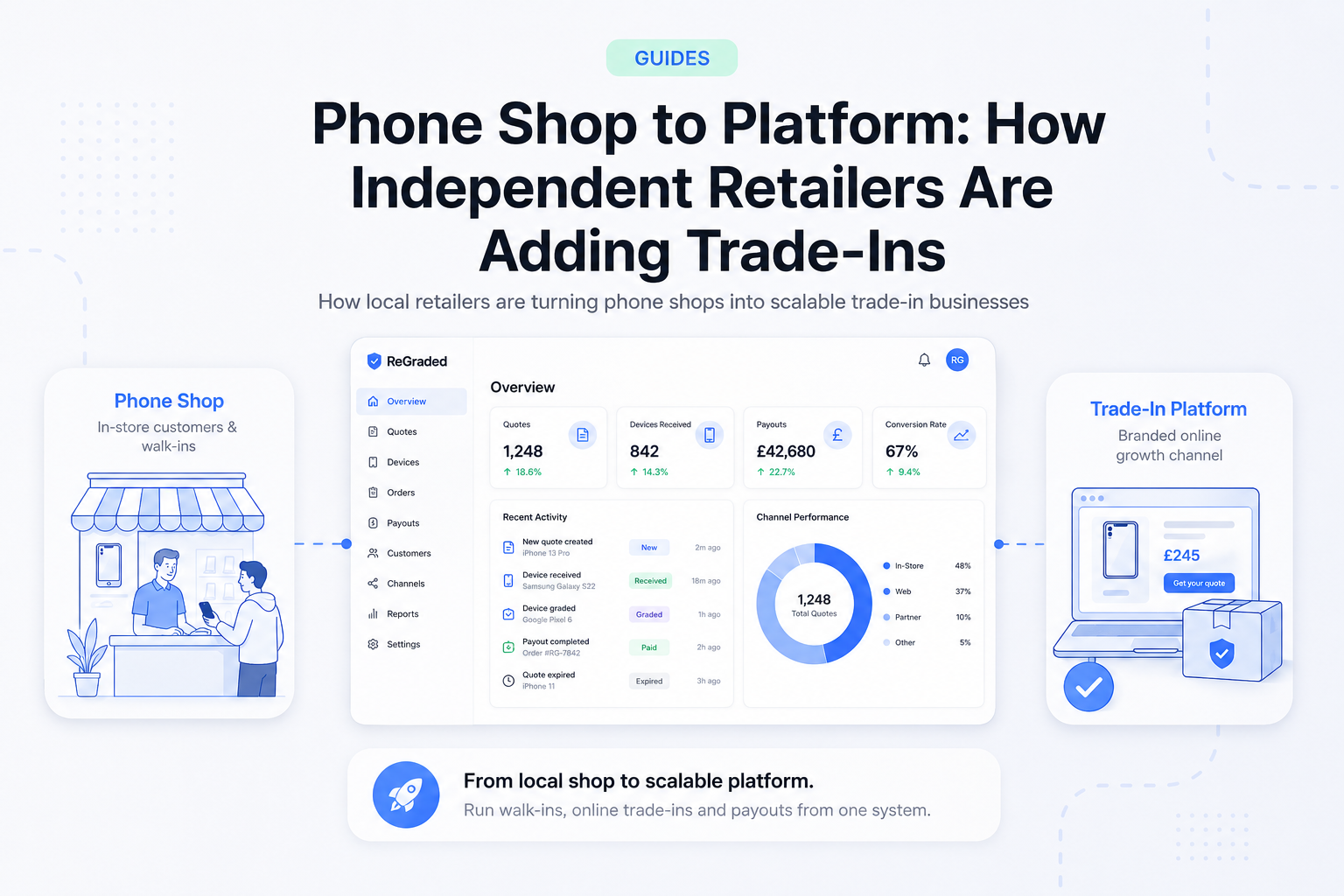
A spreadsheet starts to hurt when volume grows: bookings get missed, payments get forgotten, and you can't see what each phone cost you once it's sold. That's the point to move to software built for trade-in. ReGraded, the platform I build now, runs the buying side (your branded quote site, bookings, postage labels, testing records and customer payments) so you can concentrate on buying and selling well. Whatever you choose, our trade-in platform buyer's guide sets out the questions to ask before you sign up.
Your first 90 days
Here's how I'd use the first three months, without guessing at numbers that depend on your market and your money.
Days 1 to 30: set up. Register the business, pay the ICO fee and sort out a business bank account. Decide your channel (online, walk-in or both). Write your grade definitions, choose your testing and IMEI-check tools, set up postage and payments, and build a price grid for a narrow range of phones you know you can sell. Put your terms in writing: what happens to a locked phone, a phone that isn't as described, and a payment that fails.
Days 31 to 60: start buying. Buy within that narrow range. Check every phone before you pay, pay quickly, and ask every happy customer for a review. Sell your first stock through one or two channels. Write down every revised offer, every return and every dispute, and why it happened.
Days 61 to 90: review and adjust. Look at which phones made money and which didn't, how accurate your grading was, where your stock sold fastest and how much cash is tied up in stock. Fix your prices and your process before you widen your range. Grow when the process holds, not before.
My recommendation
After nine years and a lot of phones, the lesson I'd pass on is the one I started with: customer service and reviews matter as much as paying the most. A business that quotes honestly, pays what it quoted and pays quickly earns reviews, and reviews bring the next customer more cheaply than any price rise.
So start narrow. Buy direct from the public, check every phone before you pay, test and grade it the same way every time, and sell where you keep the most of the price. Get that working, then grow.