The customer behaviour shift is real and it's permanent. Trading in an old device when buying a new one is no longer a power-user move — it's the default expectation among under-40s and rapidly becoming the default everywhere else. Apple, Samsung, and every major carrier built trade-in programmes years ago. Currys and John Lewis followed. Independent electronics retailers are still mostly catching up, which means there's a window — but not for much longer.
Why electronics retailers are adding trade-in
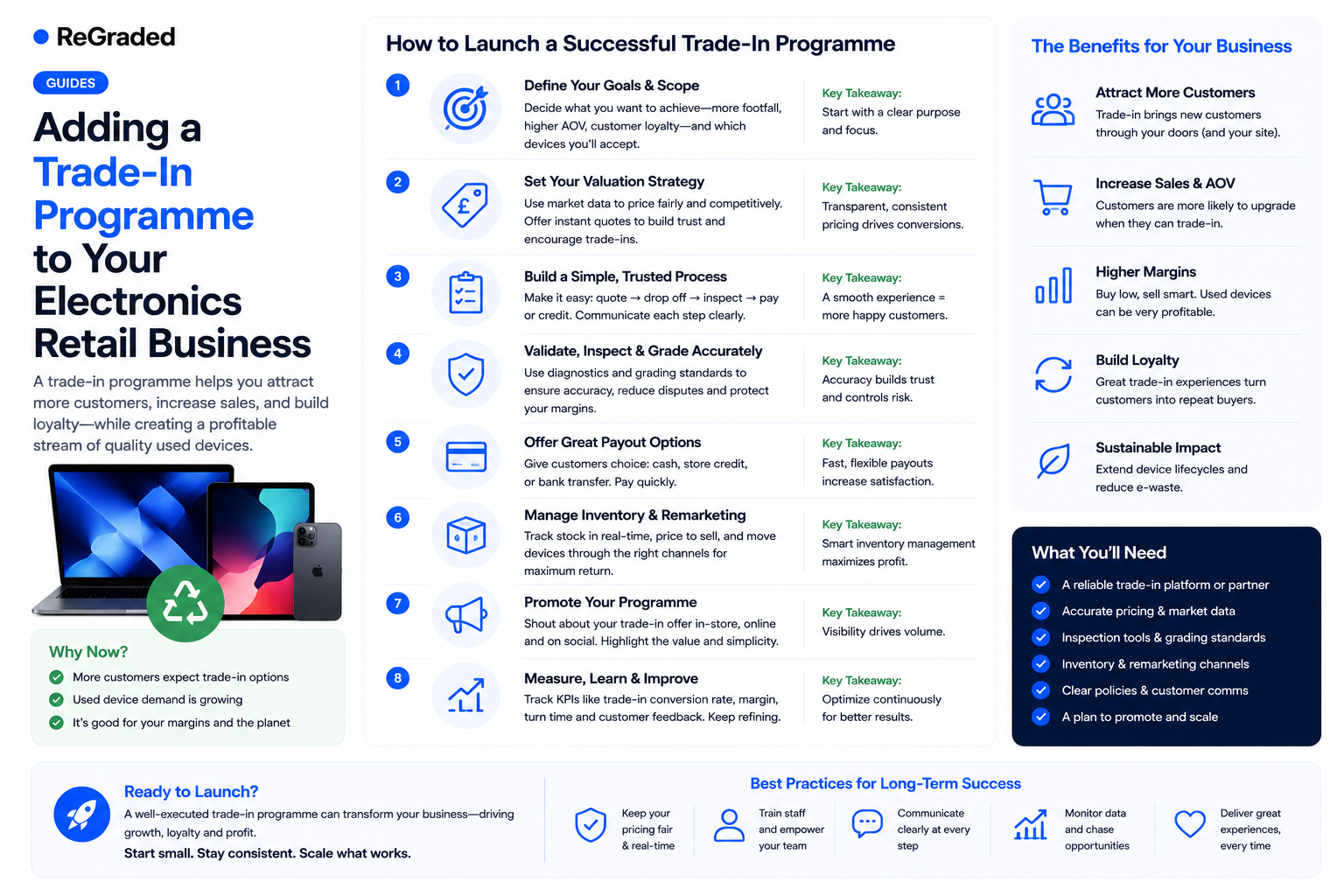
The commercial logic is straightforward. A trade-in programme gives you:
A new revenue stream from a customer base you already have — the device they're trading in goes through your pipeline and resells for a margin.
Increased footfall, especially for in-store walk-in trade-ins where customers come in to sell and stay to look at new stock.
Higher customer lifetime value, because trade-in customers are by definition upgrading — they're already in a buying cycle.
Differentiation, particularly in towns where you compete with the same handful of chain stores doing the same things.
Sustainability credentials, which matter increasingly to younger customers and to corporate buyers.
The financial reality is that an established phone shop adding a trade-in programme typically sees 20–40% of trade-in customers convert into a new-device sale within 30 days. That's a real number to model into the business case.
What you actually need to launch
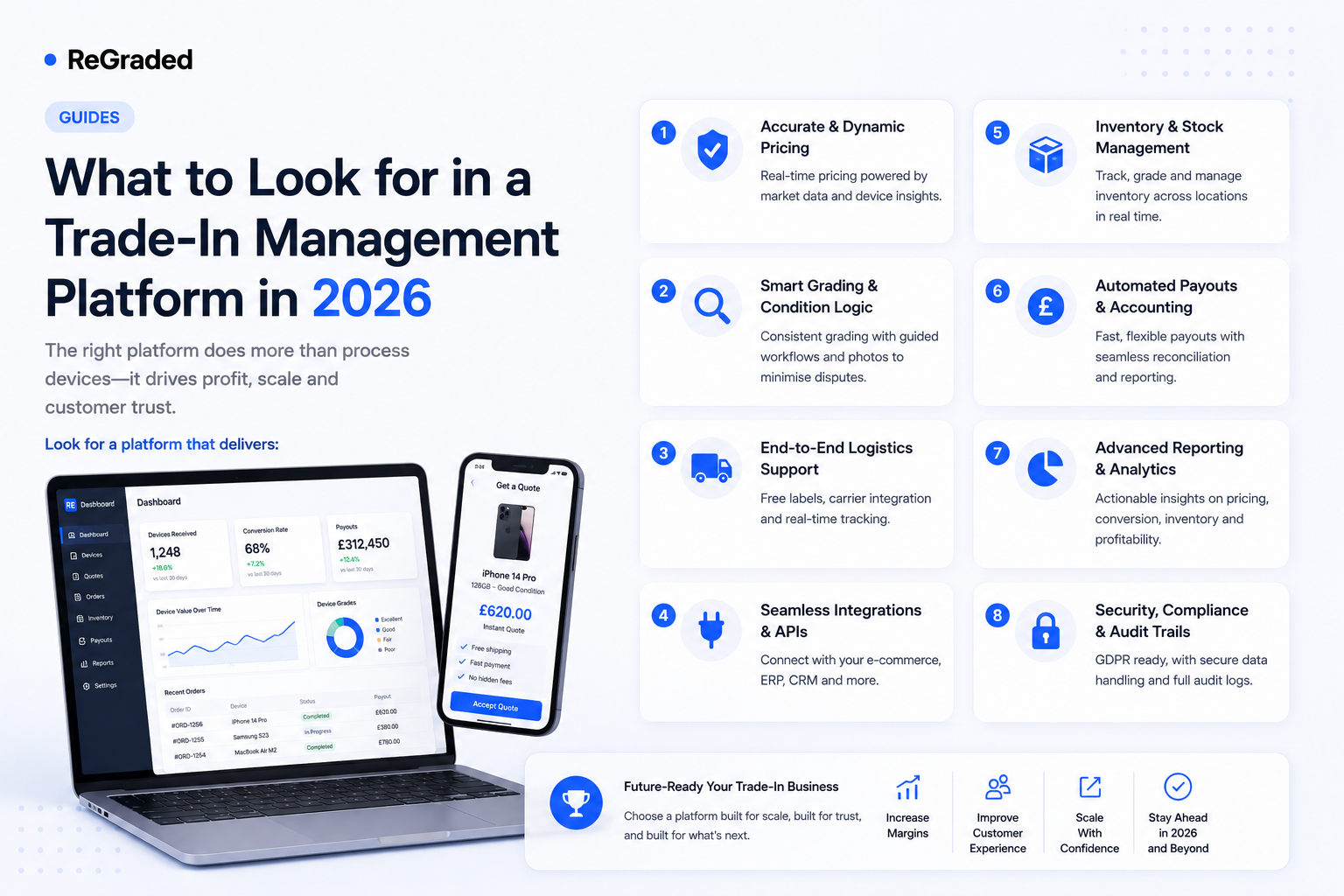
The operational requirements are smaller than most retailers assume. To launch a credible trade-in programme you need:
A branded customer-facing website where people can get an instant quote on common devices.
A walk-in counter process for in-store trade-ins, with consistent grading and on-the-spot payment.
A grading system — a clear checklist that produces consistent results across staff and locations.
Payment processing, both at the till and for postal trade-ins (bank transfer is standard).
Postage labels for postal trade-ins, generated automatically.
A way to track devices from receipt through testing, grading, payment, and resale.
That looks like a lot. A platform like ReGraded ships every one of those capabilities as standard, configured for your brand, with a preview site in 48 hours. The thing that used to require a developer, a year, and £30k now requires a setup call.
What you don't need
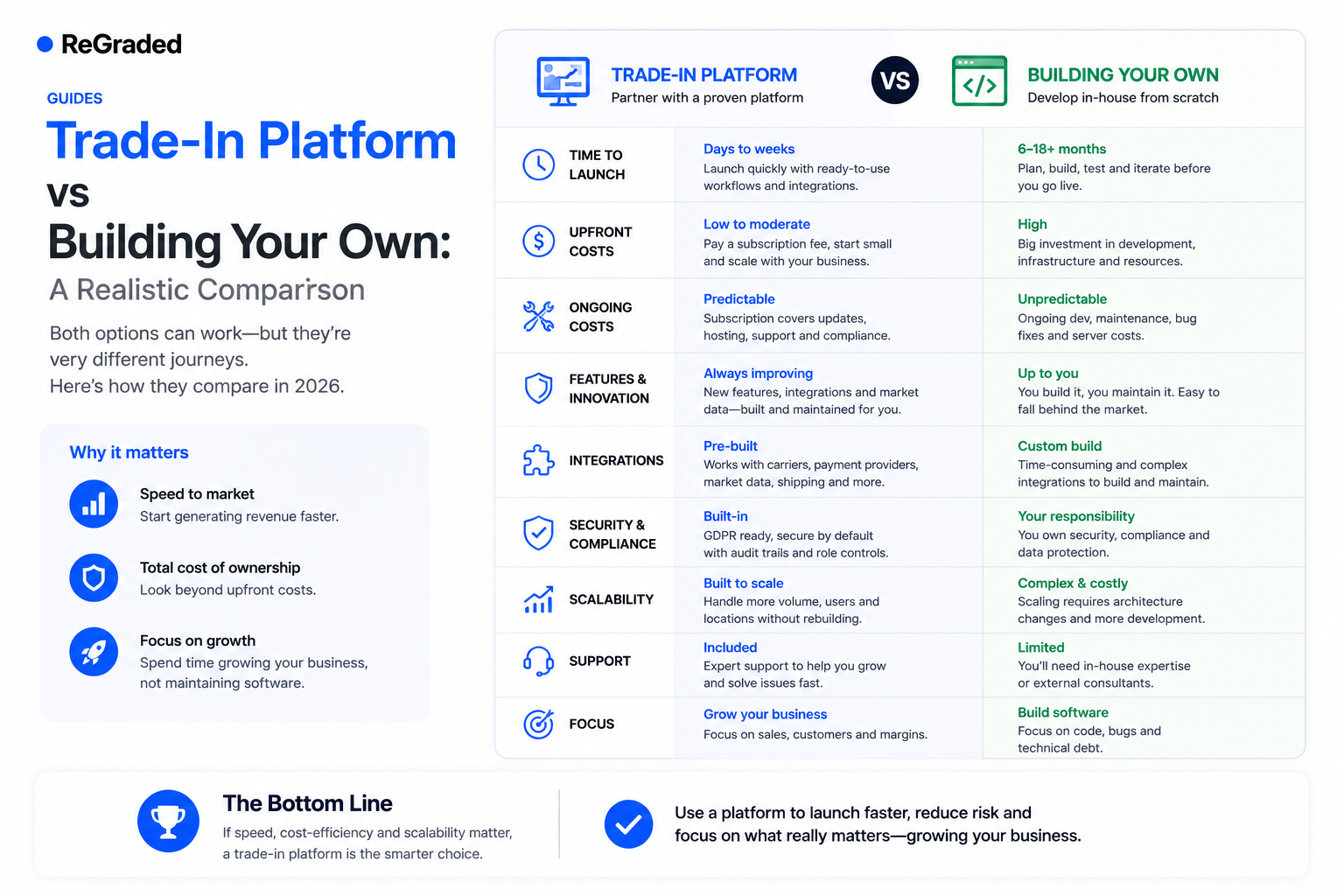
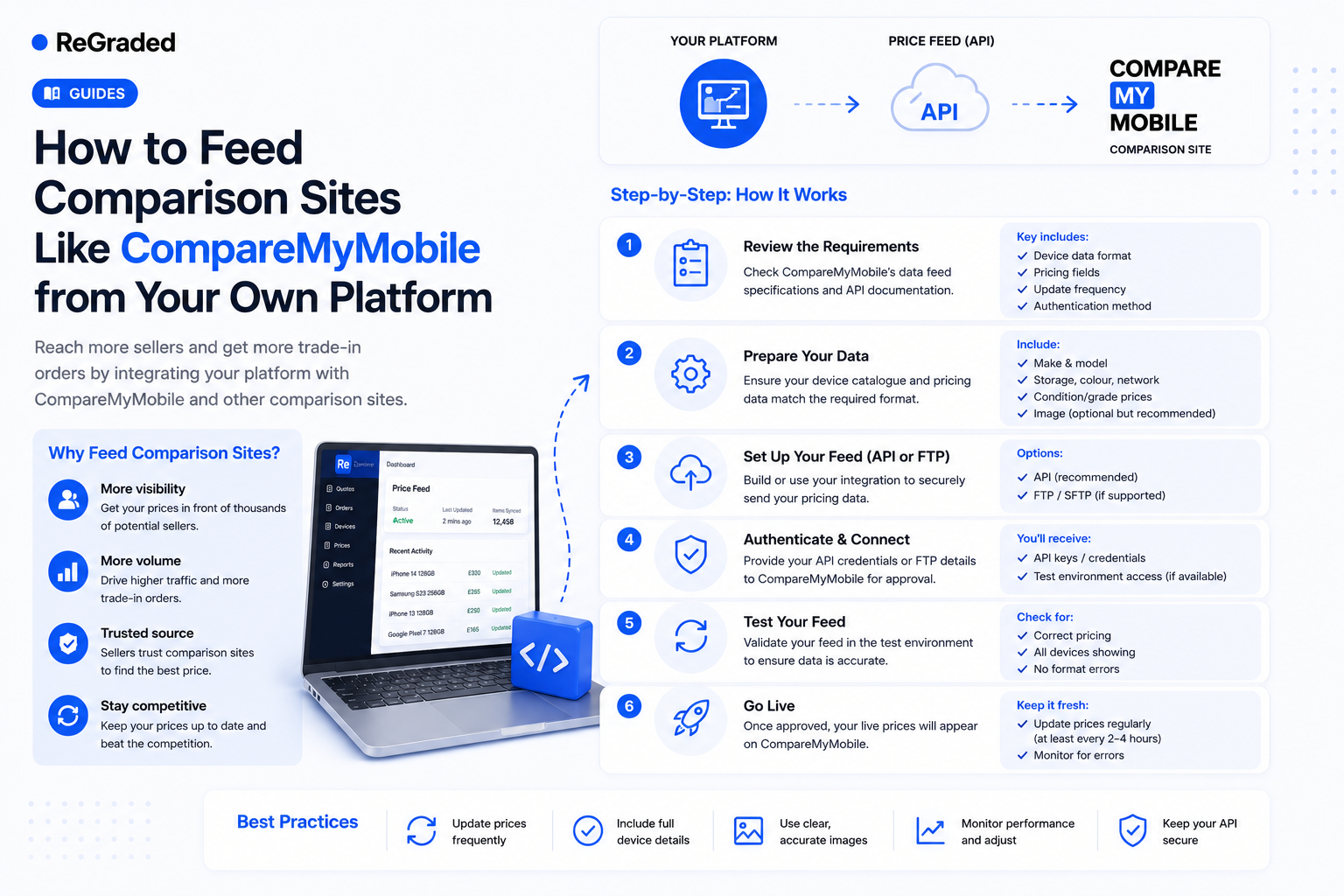
Equally important is what you don't need. You don't need a development team. You don't need months of build time. You don't need a massive upfront investment. You don't need to figure out compliance, transactional emails, comparison-site integrations, or payment reconciliation from scratch — those are all part of the platform. Your job is to bring the brand, the prices, and the customers; the platform brings everything else.
This is the part most retailers undervalue at the start of the conversation. The reason building your own is the wrong answer is exactly that a trade-in operation isn't a website — it's an operations platform, and operations platforms are vastly more expensive to build than they look.
Addressing the real fears
The objections most retailers raise are predictable, and they all have clean answers:
"I don't know how to grade devices accurately." The platform gives you configurable testing checklists per device type. You don't have to invent grading from scratch — you start with sensible defaults and tune them as you go. Staff training takes hours, not weeks.
"What if I pay too much?" Condition-based pricing with network and storage deductions handles the variability automatically. You set your price points; the platform applies the right deductions based on what the customer selects and what your inspector confirms. The chance of overpaying drops to near-zero once you trust the grid.
"How do I handle devices that arrive worse than described?" This is exactly what the revaluation workflow is for. The customer gets a clear, professional revised offer with photo evidence; they accept, decline, or request return. No drama, no awkward emails. Our existing piece on revaluations covers the workflow in detail.
"What about returns and disputes?" Configurable return-fee workflows cover postage and handling if a customer declines a revised offer. Disputes are rare when the process is structured; customer-facing self-service resolves most of them without staff involvement.
Devices beyond phones
Phones are the obvious starting category, but most electronics retailers find tablets and laptops are an easy expansion. The platform's catalogue is configurable — adding tablets or laptops doesn't require a new system; it requires you to set the prices for those categories. Same workflow, same pipeline, same dashboard. The marginal cost is tiny; the marginal upside is significant.
The launch timeline
From signing up to taking your first trade-in is typically 48–72 hours. Setup involves: choosing your domain and branding, importing your price grid (or starting from a template), configuring your grading checklist, and connecting payment and shipping. Most retailers go live with postal trade-ins on day one and add walk-in buying within a fortnight as staff get comfortable with the counter workflow. The 48-hour onboarding page walks through the full process.
The honest summary
Adding a trade-in programme isn't risk-free, but it's significantly less risky than most retailers assume. The infrastructure already exists, the workflows are battle-tested, and the customer demand is provably there. The longer you wait, the more your competition gets there first. The right time to launch is roughly six months before you actually do it.
If you'd like to book a demo, we'll walk through what a launch looks like for your specific shop — pricing, branding, walk-in setup, and the first thirty days. Or look at pricing — every feature in this piece is included at every tier, because trade-in isn't a premium add-on; it's the platform.