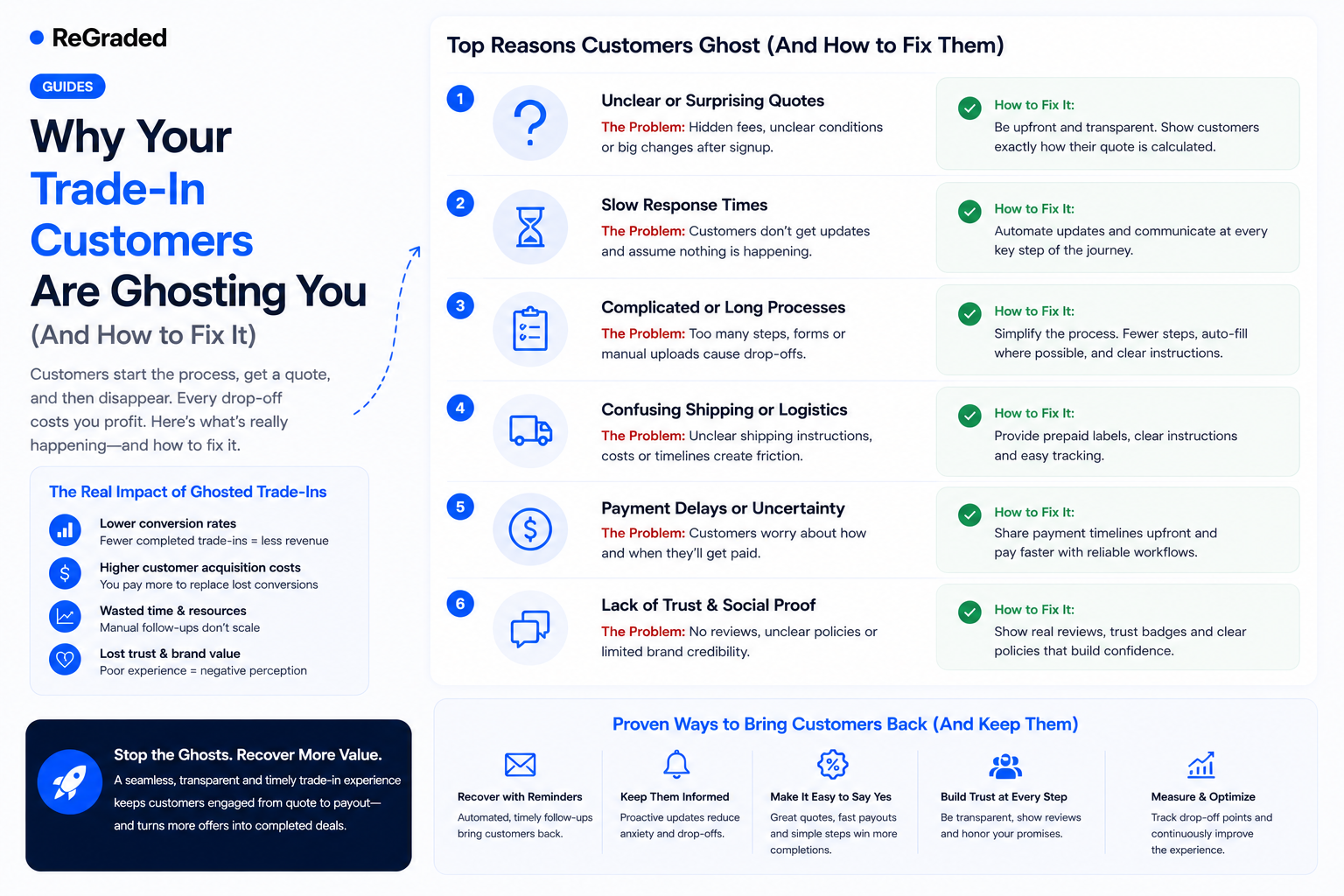
Here's an uncomfortable industry statistic. Across most trade-in operators, somewhere between 20% and 30% of bookings never convert into a received device. The customer got their quote, maybe even printed the postage label — and then never posted the phone. They've ghosted you.
If your conversion-to-received rate is sitting at 75%, you're not unusual. You also have a quarter of your potential revenue evaporating between booking and post box. Closing even half that gap is one of the most underrated wins available in the business.
Why customers actually ghost
Operators tend to assume ghosting is about price — that the customer got a better offer elsewhere and silently defected. Sometimes that's true. But more often, ghosting is about friction. The honest reasons people don't post:
Life got in the way. They booked on a quiet Tuesday evening, meant to post on Thursday, and the week ran away.
They couldn't find the label after their email auto-archived it three days later.
They forgot what they were meant to do after booking — print, package, post, drop at which post office?
They got distracted by a competing decision (keep the phone for the kids, give it to a relative).
They lost confidence after six days of silence and assumed the booking had lapsed.
Notice that "better offer elsewhere" isn't on the list. Most ghosters didn't actively reject you — they passively drifted. Which means most of them are recoverable if you stay visible without being annoying.
The real cost
Put a number on it. At 100 bookings per month with a 25% ghost rate, you're losing 25 devices monthly. If those devices average £150 in resale value, that's £3,750/month in lost gross revenue — £45,000 a year. The acquisition cost of those bookings (the marketing spend, the comparison-site share, the support time) is sunk; the only way to recover any of it is to convert them.
This is why drop-off recovery has a higher ROI than almost any other process improvement. You're not buying new traffic; you're salvaging traffic you've already paid for.
Automated reminder sequences
The single biggest lever is structured, automated email reminders. Not nag emails — useful, timely, low-effort prompts that re-surface the booking in the customer's life. A sequence that works in practice:
Day 0: Booking confirmation, with the postage label attached and clear next steps.
Day 3: "Just a reminder — your label is ready. Drop the phone at your nearest Royal Mail point."
Day 7: "Still got your phone? Here's the label again — no rush, but the quote is held for 14 days."
Day 13: Final reminder before the quote lapses.
Each one should be branded, friendly, and include the label or a one-click link to it. Branded transactional emails are how this sequence stays helpful rather than spammy — a generic "your booking is pending" email reads like a debt-collection letter.
Free pre-paid postage labels
If your label is anything other than free and pre-paid, you're filtering out ghosters with one of the worst possible filters: friction at the moment of action. The customer who'd otherwise have posted the phone now has to "deal with postage" and decides to deal with it later — and "later" is the technical term for "never".
Royal Mail labels generated automatically at the moment of booking, attached to the confirmation email, and re-attached to every reminder — this is the baseline. Native shipping integrations mean the platform produces the label without staff intervention, which means every customer gets one, every time, without exception. The shipping mistakes operators make piece goes into more detail on why this matters.
Tracking sync makes everything else work
You can't recover ghosters effectively if you don't know which bookings have actually been posted. Tracking sync — the platform watching the shipping carrier and updating each booking's status as it moves — gives you exactly that picture. The operator dashboard can show "23 bookings still pre-transit after 7 days" and trigger the right reminder for that segment automatically. Without tracking sync, you can't even see the problem clearly.
Customer accounts close the loop
Customers who can log into an account and see their booking status — "you've booked, your label is ready, we're waiting for your device" — are demonstrably less likely to ghost. The booking stays in their head because it has a visible existence somewhere they can return to. Forget the email? Log into the account. The label is right there, the status is right there, the deadline is right there. Customer accounts are a low-glamour feature that quietly drives conversion.
The booking expiry conversation
Quotes should have a clear expiry — typically 14 days — and the customer should know it from the start. This isn't about being rigid; it's about being honest. Used-phone prices drift, and a six-month-old quote is meaningless. Communicating the expiry upfront ("posted within 14 days for this price") gives the customer urgency without pressure, and lets you treat ghosted bookings cleanly: the quote lapsed, the customer can re-quote, no awkward conversations.
The cumulative win
None of the levers above is individually transformative. Each one might lift your conversion rate by a couple of percentage points. Stacked together — automated reminders, free labels, tracking sync, customer accounts, clear expiries — they routinely move operators from 75% conversion to 85%+. That's an extra 10 received devices per 100 bookings, with no extra marketing spend.
If you'd like to see the full drop-off recovery stack in action, we'll walk through the email sequences, the tracking dashboard, and the customer account view. And pricing includes every piece of it at every tier — because losing a quarter of your traffic is the kind of problem you fix once and never re-visit.