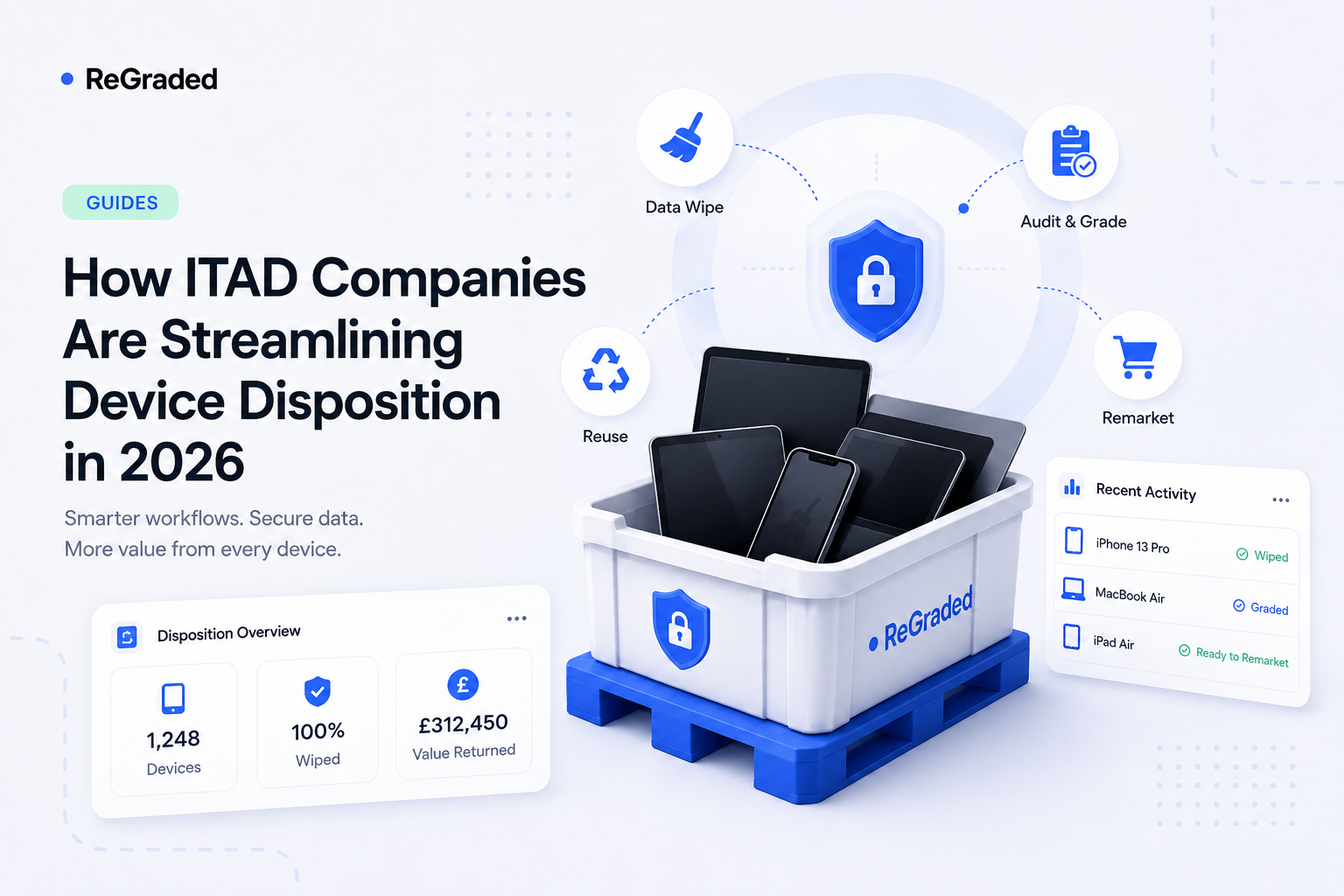
IT asset disposition is having a moment. Corporate refresh cycles are compressing — what used to be a four-year hardware lifecycle is now closer to three, sometimes two for senior staff devices. WEEE compliance, data-destruction obligations, and rising scrutiny of secondary-device handling have turned ITAD from a back-office afterthought into a regulated, audited, board-visible function. The commercial opportunity in refurbished resale is real, but only for operators who can handle the volume and the compliance simultaneously.
The platforms that win this market in 2026 are the ones that take ITAD seriously as a workflow problem, not a consumer-trade-in problem dressed up for business buyers.
The ITAD challenge at scale
A typical ITAD intake looks nothing like a consumer trade-in. It's a corporate client sending you hundreds — sometimes thousands — of devices in a single batch. Each device needs:
Identity verification — IMEI for phones, serial number for laptops and tablets, asset tag reconciliation against the client's inventory.
Condition grading against a structured checklist, with photo evidence.
Data wipe confirmation — most contracts require a certified erasure step before any resale.
Pricing against the contract terms — sometimes a fixed per-device rate, sometimes condition-based, often a mix.
Processing at volume — receive, scan, grade, wipe, photograph, price, and stage for resale or recycling.
Payment to the corporate client, with reporting per batch and per asset.
An audit trail that survives procurement review, internal audit, and (in some sectors) regulatory inspection.
Generic consumer trade-in tools collapse under this load. Spreadsheets are out of the question. POS systems aren't relevant. Even most "buyback platforms" struggle past the first hundred devices in a single batch — they were built for one-customer-one-device, not one-corporate-thousand-devices.
Why generic tools fail at ITAD volume
The failure modes are predictable. Tools built for consumer trade-in tend to:
Treat each device as a separate "order", creating a thousand sub-records instead of one batch with a thousand line items.
Fall apart at bulk grading — there's no efficient way to grade fifty devices in succession against the same checklist.
Lack contract-aware pricing, so every device needs to be priced individually rather than against a pre-agreed rate card.
Produce per-customer reporting rather than per-batch or per-client reporting, which is what the corporate buyer actually wants.
Have no concept of "data wipe complete" as a workflow gate, so it gets tracked in a separate spreadsheet that promptly drifts.
The result is that ITAD operations on generic tools end up running half their workflow outside the tool — bulk grading in spreadsheets, data wipe tracking in a separate system, billing reconstructed manually each month. The audit trail is fragmented across systems and the moment someone asks a hard question, you can't answer it.
What ITAD operators actually need
Purpose-built ITAD workflow is built around the batch, not the device. The platform should let you:
Upload a CSV or spreadsheet of incoming devices — IMEI/serial, asset tag, model, expected condition — and have the platform create the batch in one operation.
Process devices in volume — grade fifty in succession without context-switching, capture photos efficiently, and apply structured testing checklists per device type.
Track data-wipe status as a first-class step in the workflow, with certification documents attached per device.
Apply contract pricing automatically — different clients on different rate cards, with the right one selected by batch.
Report per client and per batch — devices received, devices passed, devices failed, total value, exceptions.
Maintain a forensic audit trail per device — every action, every staff member, every timestamp, every photo, accessible months later when someone asks.
This is exactly what ITAD-specific platform features are designed around. Our existing piece on scaling enterprise device trade-ins goes deeper into the operational shape of running this at volume.
The compliance angle
ITAD operations live inside a tighter compliance envelope than consumer trade-in. Data protection (UK GDPR, sector-specific data regimes for financial and healthcare clients), waste management (WEEE), chain-of-custody documentation, and certified-destruction audit trails are all standard requirements rather than nice-to-haves.
The platform's role here is structural: it should make compliance the default path, not an extra step that staff might skip. Encryption at rest, role-based access, and per-device audit trail aren't optional features for ITAD; they're the licence to operate. We cover the broader case in why every trade-in business needs an audit trail, and the requirements get sharper still at corporate scale.
Bulk order processing as a first-class concept
The single most important architectural choice is whether the platform treats bulk orders as a first-class entity. A bulk order is a single contractual unit with a corporate client; underneath it are many devices, many statuses, many payments. The platform should let you view, report, and bill at the bulk-order level while still tracking each device individually.
Without this, ITAD operators are constantly aggregating manually — re-creating the bulk picture from individual device records. Native bulk order support changes the daily reality: you see the batch, drill into devices when needed, and report up to the client in their language, not yours.
Resale routing
The other half of ITAD is what happens to devices after disposition. Some go to refurbished resale (consumer or B2B), some to parts harvest, some to recycling. The platform should let you tag each device's onward route at the disposition step and produce reporting on it — which gives the corporate client the sustainability metrics they increasingly want, and gives you operational visibility into which channels are absorbing volume.
The market direction
ITAD is consolidating. The smaller, spreadsheet-driven operators are losing tenders to platform-native competitors who can produce a same-day audit pack for a procurement review. The corporate buyers driving this aren't tolerating manual-and-slow any more — they're scoring vendors specifically on platform capability. By 2027, "we run on spreadsheets" will be a dealbreaker for any contract over a hundred devices. The right move is to be on the platform side of that shift, not the spreadsheet side.
If you'd like to walk through an ITAD-specific demo, we'll show you bulk order intake, batch processing, audit trail, and the per-client reporting view. Or look at pricing — enterprise tiers include the bulk-order workflow and audit capabilities you need to bid for and win corporate ITAD contracts.