If you run one phone shop, trade-ins are messy but manageable. A spreadsheet, a notebook, the cash register — they all work, more or less. By the time you've got three locations, the picture is usually different. One shop uses a spreadsheet, one is on WhatsApp messages, one has a paper ledger. Prices vary between sites because nobody can keep them in sync. You don't know what's been bought across the chain until end of month — if then.
The compound effect of this is bigger than it looks. Inconsistent pricing damages the brand: customers compare shops, they post about it on Reddit, they stop trusting you. Inconsistent process damages margin: one staff member is paying too much, another is rejecting devices that would have made you money, and you can't tell which is which. Inconsistent record-keeping damages everything else: HMRC enquiries, customer disputes, payment reconciliation.
The problems that compound
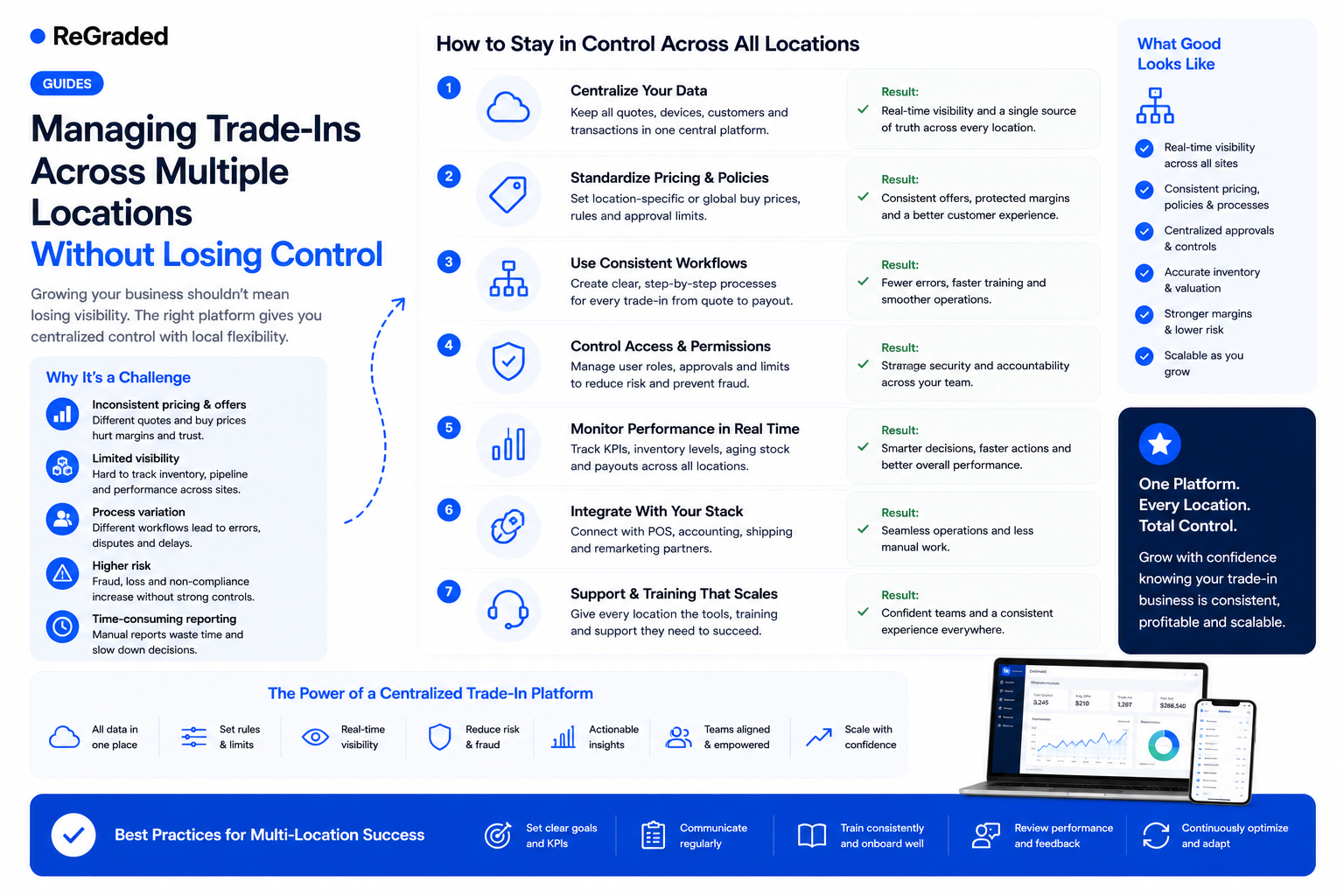
Multi-site trade-in operations without central tooling fail in characteristic ways. The list is depressingly consistent across operators:
Pricing drift between locations. Site A pays £180 for an iPhone 12 in good condition; Site B pays £165. Customers find out.
Inconsistent grading. Staff at different shops apply different standards to the same condition criteria, producing wildly different gross margins per shop.
No central audit trail. A device bought in Site A, tested in head office, paid from a central account, disputed three weeks later — and nobody can reconstruct the chain.
Duplicate payments. Two systems with the same customer entered slightly differently, and the customer gets paid twice.
Staff using different processes. Each site optimised locally, none consistent enough to train, scale, or troubleshoot.
Impossible reporting. "How much did Site C buy this quarter?" becomes a half-day spreadsheet job.
Each of those individually is annoying. Together they're a ceiling — they prevent the chain from growing past five or six locations because the operational chaos becomes unmanageable.
One price grid, updating everywhere
The first thing that has to centralise is pricing. A single price grid — make, model, storage, network, condition — pushed to every location instantly, with a complete change history. Update the iPhone 13 price once, and every site sees it within seconds. No more "the price grid was emailed on Tuesday but the Manchester shop didn't read it until Friday".
This is the lever that makes price discipline possible. Without it, you're managing pricing by Slack message. With it, pricing is just another configuration that updates everywhere. Centralised operations is where this kind of single-source-of-truth control lives.
One pipeline, one dashboard
The second centralisation is the operational view. Every device, regardless of which site bought it, lives in one pipeline. The head office sees the full picture; each site sees their own slice. The pipeline view shows status, location, value, and SLA breaches across the entire chain at a glance.
This is where the multi-site operator stops feeling like a referee and starts feeling like a manager. The dashboard tells you which site is busy, which is slow, which has devices stalled in "received but not tested", and which is breaching payment SLAs. None of that is visible without central tooling. Trade-in management at scale is exactly this — every channel, every site, one view.
Walk-in buying is the workhorse
For multi-site operators, walk-in buying is usually 60–80% of total volume. Postal trade-ins ride on top, comparison-site orders feed in, but the day-to-day reality of a chain of phone shops is people walking in to sell their phone at the counter. The platform's walk-in capability has to be excellent: instant pricing at the till, instant payment (cash or transfer), ID capture for compliance, per-device audit trail, and pipeline integration so head office sees it the moment it happens.
Without proper walk-in support, the multi-site operator falls back to paper-and-spreadsheet at the counter, which undoes everything else. With it, every counter becomes a node in the same network. Walk-in buying vs online goes into how the unified-pipeline model works in practice.
Per-location reporting, finally
Once everything flows through one platform, reporting becomes trivial. Devices by site, gross margin by site, SLA breaches by site, staff performance by site. The conversations that used to be "I think Site C is underperforming" become "Site C is paying 7% more for the same devices as Site A — let's find out why". This is the level at which a chain becomes manageable instead of just operable.
It also makes incentive structures possible. You can pay site managers on margin contribution rather than headline volume, which aligns their behaviour with the chain's profitability. Without per-location data, the incentive is always "more devices" — which is often not the same thing as "more profit".
The compliance and audit angle
Multi-site operations attract more scrutiny — from HMRC, from data-protection regulators, from comparison-site partners running due diligence. A central audit trail with staff attribution, photo evidence, and complete event logs per device isn't a nice-to-have; it's what makes the chain defensible when someone asks awkward questions. The case for a proper audit trail applies doubly to multi-site operations.
The use case in one paragraph
If you run more than one location, the marginal cost of central tooling drops to zero very quickly. Two sites might survive on spreadsheets; three is painful; five is impossible. Building the central platform yourself is the slowest, most expensive route — every issue we listed has already been solved on operator-grade platforms. Multi-site trade-in operators use ReGraded specifically because the platform was built with multiple locations as a first-class concept, not an afterthought.
If you'd like to see the multi-site dashboard in action, we'll walk through a live demo across two test locations. Pricing includes multi-site support at every tier — you pay per location, but every feature is included from the first site.