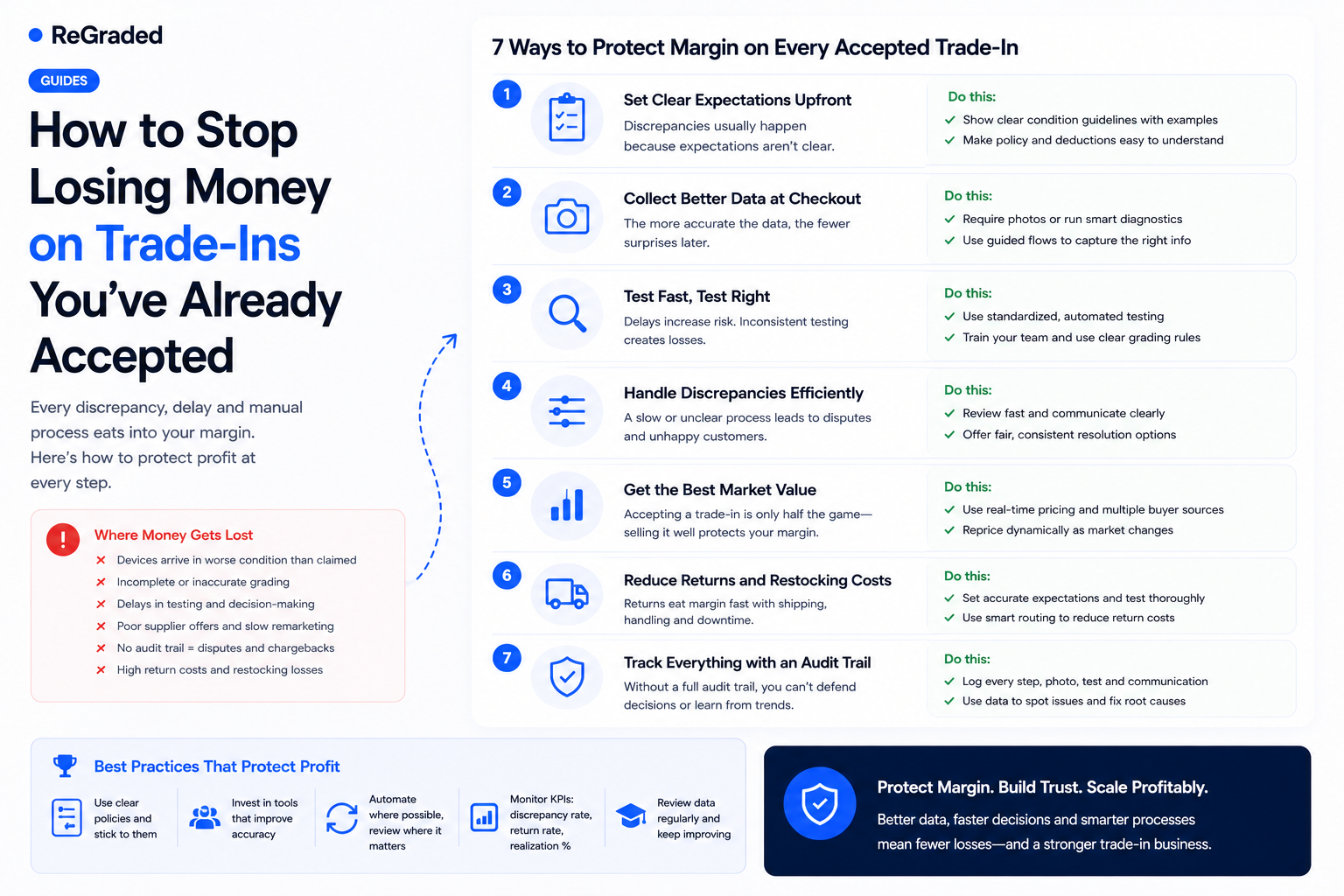
Every trade-in operator has the same story. A customer self-grades their phone as "excellent". The device arrives with a scratched screen, a cracked camera lens, and a battery sitting at 78%. Now what? Either you honour the quote and absorb the loss, or you push back and risk a complaint, a chargeback, and a one-star review. Most operators eat it, because the alternative feels worse. The compounding cost of that decision is enormous.
What this actually costs you
Let's do the maths honestly. If 20% of devices come in materially worse than the customer graded them — which is a conservative number — and the average price gap between grades is £30, then for every 100 devices you receive, you absorb £600 of avoidable loss. At 500 devices a month, that's £3,000. Over a year, you've quietly given away £36,000 in margin you should have kept.
This is one of those costs that doesn't show up anywhere obvious. It's not in your P&L as "misgraded losses"; it's just lower margin per device than your pricing should have produced. The first sign for most operators isn't a number — it's a vague feeling that the business "should be making more than it is".
Why operators eat the loss
The reason most operators don't revalue is that they don't have a process for it. They have a vague intention to "send the customer a message" if a device is worse than described, but the actual mechanism is a manual email, written from scratch, hoping the customer responds. The whole thing feels adversarial and time-consuming, so the path of least resistance is to pay the original quote and move on.
That's the trap. Without a structured workflow, revaluation feels like a fight every time. With one, it's just another routine step in the pipeline.
What a proper revaluation workflow looks like
The shape of it is simple, but every step matters. The platform should let an inspector:
Mark the device against the actual condition criteria — not free-text "looks worse", but specific failures against your published grading checklist.
Capture photo evidence at the point of inspection, attached to the device record.
Generate a revised offer automatically, with the new price, the reasons (clearly listed), and clear next steps.
Send the customer a professional, branded email with accept, decline, and return options.
Let the customer self-serve — they accept the new offer through their account, request the device back, or escalate to support.
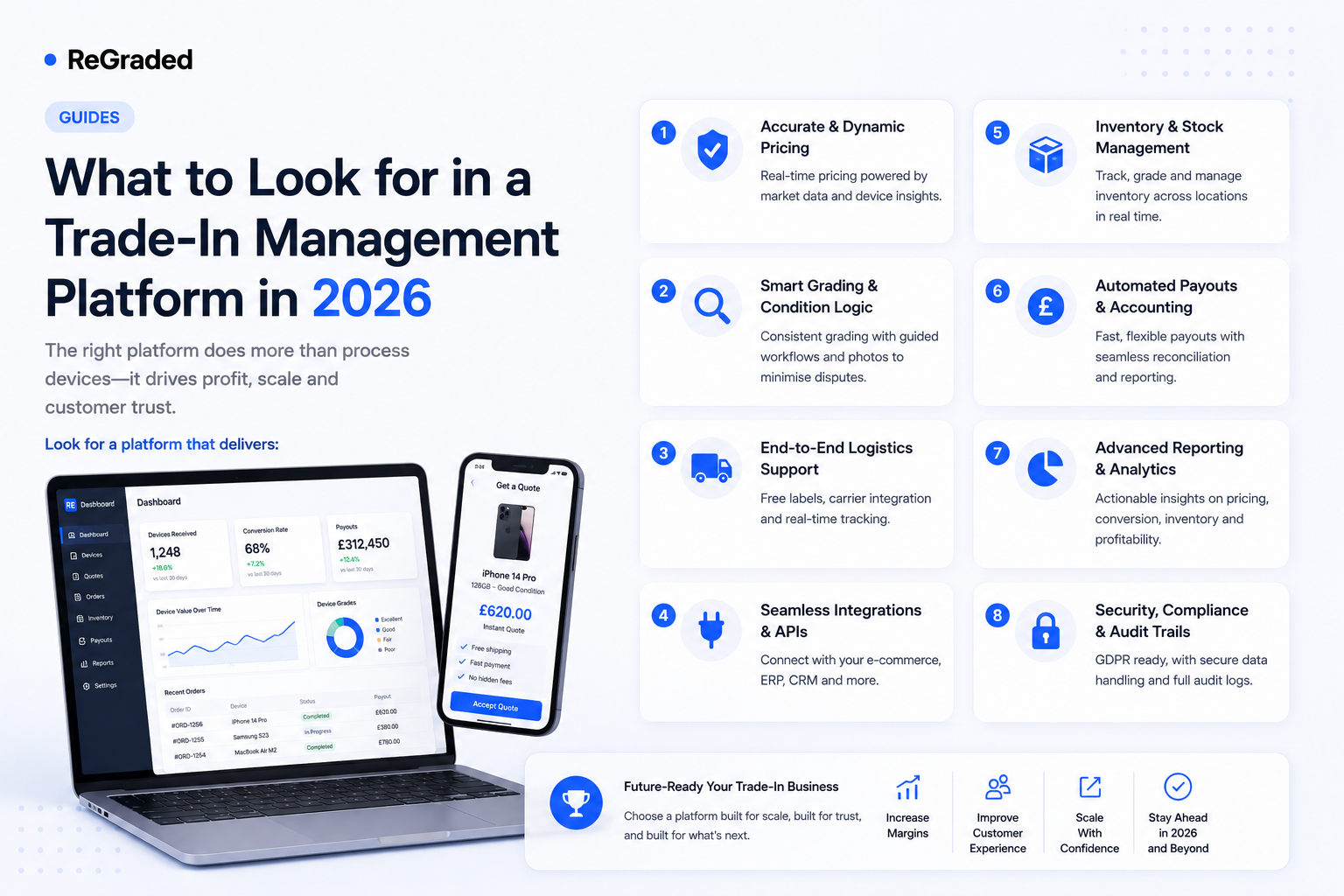
The whole sequence runs in five minutes, not five days of email back-and-forth. And critically, it doesn't require the inspector to draft anything; the templates and pricing logic do the heavy lifting. Operations workflow features are where this kind of structured discipline lives.
Evidence is the difference
The single biggest reason revaluations succeed or fail is photos. A customer who sees three clear photos of the scratched screen, the cracked camera lens, and the dented frame is overwhelmingly likely to accept the revised offer — because it's not your word against theirs, it's a record. Without photos, every revaluation is a dispute waiting to happen.
The platform should make photo capture part of the inspection process by default, not an optional extra step that gets skipped under pressure. Every revaluation email goes out with evidence attached; every audit trail entry references the same photos. We go into the broader case for evidence in why every trade-in business needs an audit trail, but it shows up most acutely here.
The return option is non-negotiable
If a customer doesn't accept the revised offer, they need a clean way to get the device back. This is what separates a professional revaluation workflow from a sales tactic: the customer is in control. Either they accept the new price, or the device is posted back to them — usually with a small, clearly disclosed return fee to cover postage and handling. Customer-facing features like configurable return-fee flows make this trivial; without them, it becomes a manual customer-service ticket every time.
Counter-intuitively, the existence of a clean return option reduces disputes. When customers know they can get the device back, they're far more likely to accept a reasonable revised offer — because the implicit threat ("we've got your phone now") is gone. Trust goes up, not down.
The customer experience matters
Done badly, revaluation feels like an ambush. Done well, it feels professional — almost reassuring. The customer sent in a device, you inspected it carefully, you found things they didn't see, and you communicated all of that clearly with evidence. That's not bait-and-switch; that's quality control. Customers reward operators who handle it cleanly, often with five-star reviews specifically calling out "honest and fair" assessment.
If you'd like a deeper look at the workflow itself, our existing piece on how to handle revaluations walks through the operational steps in detail. And the same pricing principles that govern your original quotes drive the maths underneath revised offers — the platform just runs them automatically.
Stop absorbing what you shouldn't
The £36,000 a year a typical mid-volume operator loses to misgrading is real money. It doesn't vanish because you're being nice to customers — it vanishes because there's no process between "customer's claim" and "actual condition". Build the process, and the money stops leaking.
If you'd like to see how revaluations work in ReGraded, we'll walk you through a live inspection, a revised offer, and the customer-side acceptance flow. Or look at pricing — revaluation workflow is included at every tier, because it's not a premium feature; it's the foundation of operating profitably.