Almost every trade-in business starts on a spreadsheet. It's free, it's flexible, and at low volumes it's actually fine. The trouble is that spreadsheets fail invisibly. They don't crash; they just quietly produce wrong answers, and the only signal that something is wrong is the slow accumulation of mistakes that show up months later in disputes, HMRC questions, or angry customers.
By way of an example: a real operator's spreadsheet had two rows for the same customer, one spelt "O'Brien" and one "OBrien". Both got paid. Neither row had a unique reference. When the customer queried the second payment six weeks later, the spreadsheet couldn't prove which payment was for which device — because both rows were nearly identical. £180 paid out twice, and the only way to recover it would have been to phone the customer and ask politely.
That's a small failure with a small price tag. The structural failures behind it are not small.
The failure modes nobody tells you about
Spreadsheets fail in characteristic ways at scale. Every one of these is from a real operator's first painful migration to a platform:
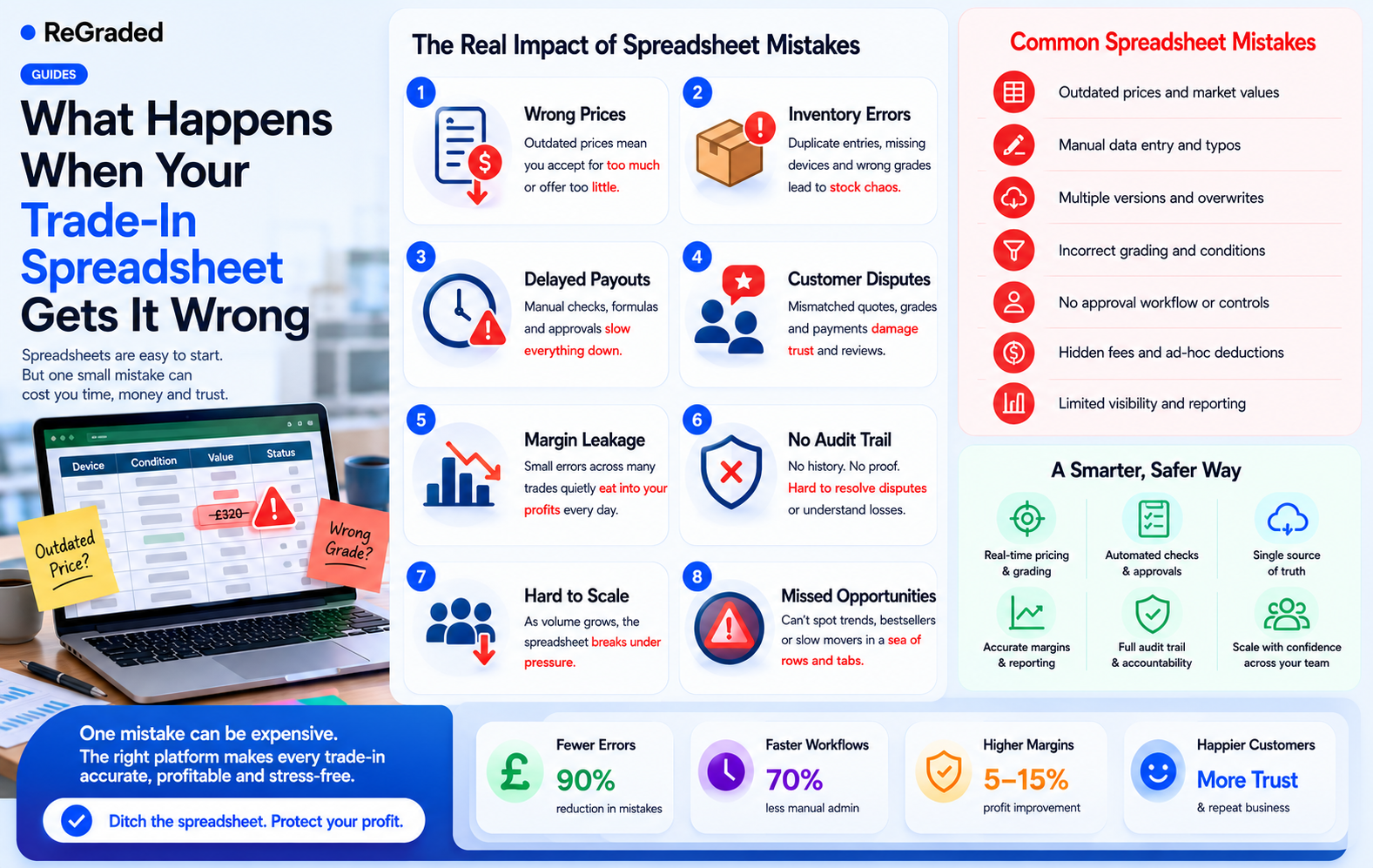
Duplicate payments, because two rows looked the same but weren't, or because the "paid" flag was missed and the payment run included the same customer twice.
Missing devices, because a row got accidentally deleted, or filtered out, or sorted into a different sheet and forgotten.
Wrong prices, because a VLOOKUP formula broke when someone added a column and now half the quotes are pulling stale prices from the wrong sheet.
No audit trail, because there's no record of who edited what or when — every change overwrites the previous state silently.
Customer disputes you can't resolve, because there's no evidence trail, no photos linked to the device record, and no way to prove what was tested or paid.
Reconciliation drift, because the bank says one number, the spreadsheet says another, and nobody can find the £42 difference.
Staff errors invisible until month-end, because nothing flags an underpayment or overpayment until someone notices the totals don't make sense.
You can't avoid these with discipline. Discipline helps; it doesn't eliminate them, because spreadsheets are structurally permissive — anyone can change anything at any time without leaving a trace.
The tipping point
Spreadsheets carry an operator comfortably up to 20–30 devices a month. They start showing strain at 50–80. By 100+ devices a month, every one of the failure modes above is happening; you just haven't found them all yet. The signal isn't usually a single catastrophic failure — it's a steady creep of small problems that consume more and more support time until the spreadsheet becomes the bottleneck.
If you're spending an hour a day "tidying" the spreadsheet, you've passed the tipping point already. We covered this transition in detail in spreadsheets vs trade-in software: when to switch — the short version is that the right time to move is usually six months earlier than people actually do it.
What replaces the spreadsheet
The replacement isn't "a bigger spreadsheet" or "a more careful spreadsheet". It's a system designed around the structural problems spreadsheets can't solve:
Unique reference numbers generated atomically per device (e.g. TB-00123) — impossible to duplicate, impossible to confuse.
Event logs on every action — who did what, when, and against which device, with a full history per record.
Database transactions on every financial write — payments are recorded once, atomically, with idempotency.
Payment batch records — every payment run is a discrete, immutable record you can audit.
Photo evidence attached to the device, surviving any subsequent dispute.
Staff attribution on every action — testing, grading, pricing, paying. Every change has a name on it.
Encrypted bank details, stored once, retrievable safely, never visible in plain text in a spreadsheet column.
None of this is sophisticated. It's just structure — the structure spreadsheets explicitly don't provide. A proper operations layer is built around exactly these guarantees.
This isn't about complexity
The common objection to platforms is "spreadsheets are simpler". They're not. A spreadsheet that runs 200 devices a month with no errors is enormously more complex than a platform that does the same — the complexity is just hidden in the head of the person maintaining the spreadsheet, the formulas they remember not to break, and the mental load of constantly checking that nothing's gone wrong.
A platform externalises that complexity into systems that don't forget. The platform doesn't get tired, doesn't accidentally delete a row, doesn't paste a price into the wrong cell. That's not adding complexity — that's removing it from the person who'd otherwise be carrying it.
The compliance angle
Trade-in businesses handle customer bank details, government-issued ID copies, and (often) significant cash flows. The audit trail isn't a nice-to-have; it's what makes you defensible when someone asks awkward questions. Platform-level security and data integrity matter precisely because the regulatory environment doesn't accept "we lost the spreadsheet" as an answer. The case for an audit trail piece walks through this in more detail.
Replace risk with records
The honest framing is this: every spreadsheet-based trade-in business is running on borrowed time. The mistakes that haven't happened yet will happen. The question is whether you migrate proactively, on your own schedule, or reactively after the first big problem. The first option is cheap; the second is expensive and usually loud.
If you'd like to see how a platform replaces the spreadsheet, we'll walk through a live import of a sample sheet and show you the same data with proper structure underneath. Pricing starts at a level that's almost always cheaper than the staff hours your spreadsheet is currently consuming.